Skip to content

Pwll y Wrach nature reserve is hidden in plain sight. If you head south from Talgarth, you’ll pass an unassuming wooden gate on the edge of Hospital Road that leads you to a path through a dense covering of trees. The path follows the course of a stream. As you venture further into the nature reserve, you’ll begin to suspect that the unassuming wooden gate was a portal to another world. The road is surely only a few metres beyond the trees; there are likely motorists speeding down it. But you can’t hear anything over the water. Beneath you the stream grows into something more. It is restless. The sound becomes deafening. Finally, you’ll see the waterfall: gallons of water cascading into a small pool. This is Pwll y Wrach: the witch’s pool.
I’m told you can see otters here, but I’ve never been so lucky. And witches too, perhaps.
I’ve visited Pwll y Wrach many times, but only once in company. On a pleasant spring morning I led a group of students from the Black Mountains College here for a writing workshop. Using a series of prompts, the students came up with stories to explain the name ‘Pwll y Wrach’. As one might expect, many gravitated towards the image of a witch; several hypothesised that the pwll might have been a ducking pool for witches in centuries past.
In fact, very few women were executed for witchcraft in early modern Wales. Why all but a handful of Welsh women escaped the persecution that killed hundreds in England and thousands in Scotland remains an intriguing historical question. We have certainly never been short of witches themselves.
Gwrachod Cymru | Welsh Witches by artist Efa Lois tells the stories of over a hundred of them from all corners of Wales. The highlight of this volume, newly published by Seren Books, is undoubtedly Efa Lois’s breathtaking illustrations. Each witch is colourfully brought to life, challenging us to view these characters as women, not as uniform caricatures with pointy hats and broomsticks. Each illustration is accompanied by a brief account of the witch’s story and the reasons for her notoriety. I particularly enjoyed Pampetris’ story, a woman who lived on Llangybi Common and turned her drunk husband into a horse.

Gwrachod Cymru tags each of the tropes with which a witch is associated, enabling the reader to compare stories and map similarities. Shapeshifting crops up again and again. As well as turning misbehaving husbands into animals, many witches themselves shapeshift. Ceridwen, perhaps the most famous witch of early Welsh literature, was a master of this craft. In Hanes Taliesin, the origin story of the medieval Welsh poet Taliesin recorded by Elis Gruffudd in the sixteenth century, Ceridwen’s servant steals a magic potion from her cauldron. A thrilling chase ensues, with Ceridwen transforming into a greyhound, otter and hawk. Eventually her servant transforms into a grain of corn which Ceridwen, transformed into a hen, swallows. She later gives birth to Taliesin, becoming the literal mother of Welsh poetry.
Among the stories of shapeshifting witches, there is an intriguing abundance of hares. The witches of Llanddewi Brefi were allegedly seen swimming as hares in the river Teifi. Both Leisa’r Lofft of Llanddeiniol and Gwrach Llanfihangel Genau’r Glyn seemed spiritually connected to their local hares, sharing sympathetic injuries with them. This association between Welsh witches and hares has prevailed into the modern era. Bethan Gwanas’s Gwrach y Gwyllt (Gomer, 2003) and Merch y Gwyllt (Lolfa, 2020) feature shapeshifting witches, and one unfortunate trio are stuck living as hares for several centuries. In these novels too, the farmer or huntsman’s gun is a very real threat. As many of the tales in Gwrachod Cymru illustrate, stories of witches and witchcraft are as much about violence against women as they are stories of evil women bewitching unsuspecting communities.
As was likely Lois’ intention, I found myself returning again and again to the question of what makes a woman a witch. I couldn’t shake the image of the hare either. But being associated with the hare does not always equate to witchcraft in Welsh literature.
According to medieval hagiography, Melangell, an Irish princess living in hiding in Powys, rescued a hare from the hunting dogs of the Welsh ruler Brochfael. The hare hid underneath her dress, and the dogs retreated. Faced with this miracle, Brochfael granted the land to Melangell. Her land became a sanctuary for animals, and she was venerated as the patron saint of hares. It’s easy to see how Melangell could have been cast in a different light, as a meddling woman who thwarted an innocent huntsman through her peculiar familiarity with hares. Melangell in this guise wouldn’t seem out of place in Gwrachod Cymru, alongside women such as Gwrach Llanfihangel Genau’r Glyn, who was injured when a hunter shot a hare in the churchyard of Eglwys Sant Mihangel, where she lived. The goalposts are constantly shifting as society decides whether it wants to venerate or persecute remarkable women – and their hares.

There are sadly no witches associated with Pwll y Wrach or Talgarth. The nearest witch is Mol Walbec, who was responsible for building Hay on Wye castle. As a giant, Pwll y Wrach would have literally been within touching distance for Mol Walbec, although she likely would have towered over the waterfall. One of the riches of folklore, of course, is that it is a live body of literature. Perhaps the story of the witch of Pwll y Wrach will crop up one day.
***
One of the prevalent tropes in Gwrachod Cymru is the act of cursing or bewitching. In many cases the witches speak, and we see a smattering of curses and counter-curses throughout the volume, often in Welsh. Gwrach Ystrad Meurig in Ceredigion tells a shephard ‘fe golli di’r oen a’r famog, a bydd yn edifar gennyt y ngwrthod felly’ (‘thou wilt soon lose both the lamb and its mother, and thou shalt repent for thus refusing me’) after he refuses to gift her a lamb. More vaguely, Dolly Llywelyn of Caeriw (Pembrokeshire) instructs the devil to take a couple who refuse her a lift, leading to the collapse of their trap. Women cursing, often in anger, occurs frequently in early Welsh literature. We see Arianrhod, in the Fourth Branch of the Mabinogi, cursing her son three times – denying him a name, weapons and a wife. In Culhwch and Olwen a nameless evil stepmother curses Culhwch that he will not have a wife until he wins the hand of Olwen, daughter of a giant. These women are not referred to as witches, but their actions place them right at home among the cast of Gwrachod Cymru.
 Implicit in these stories is the fear of a woman’s voice. This is a theme that pervades the poet Mari Ellis Dunning’s recent fiction debut, too.
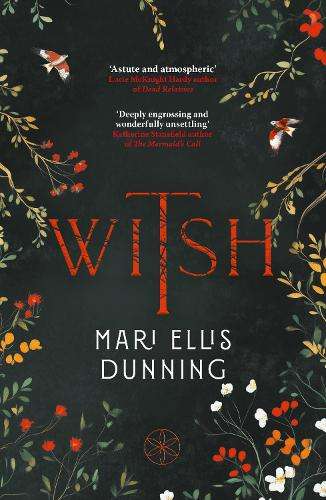
Witsh tells the story of a mid-Wales noblewoman called Doli Maredudd who is desperate to save a local healer, Sara Gwen, when she is accused of witchcraft. In the sixteenth-century world of Witsh, women could be put on trial for their words – whether spoken or written. The fertility charm that Sara Gwen gives to Doli is assumed, by Doli’s husband, to be a curse, and at her trial Sara Gwen is said to have been ‘muttering curses’ over a girl she was meant to be healing. Is said to have been – because this is a novel that has rumour at its heart. Sara Gwen’s trial is a circus of he-said-she-said. The novel shows us how a mob is something that can be created by the powerful and wielded to their own ends. At their hands, Sara Gwen turns from a healer who does her best to save a dying girl to a monstrous murderer overnight. This theme is emphasised beautifully by the novel’s structure, with Doli’s perspective interspersed with short extracts from the perspective of ‘the villagers’. In these excerpts we see how fiction becomes rumour becomes fact.
The sixteenth-century world that Dunning creates is selective when it comes to taking women’s voices seriously. One of the most powerful scenes involves Agnes, a woman who tries to help Doli. She is attacked when out collecting heather and in an effort to scare the man away shouts at him that he will regret it, that she knows people who can curse. Consoling her friend, Doli says that the threat won’t be taken seriously; and that if the man tells anyone about the incident, Agnes will be able to explain what he tried to do to her. ‘The words sounded false even to me’, a more cynical Doli by this point in the novel observes. They sound false to the reader too. Women in the world of Witsh are pushed and pushed and pushed until they snap – and then they are persecuted for it. It is exhausting. A part of the novel’s power lies in the fact that this doesn’t feel all that unfamiliar.
***
What makes a woman a witch? There is a sense in both works that witches are simply women who do not conform to how society expects them to behave – whether that is because they live alone, are good with animals, or are skilled healers like Sara Gwen. In Witsh, dispersions are even cast on Doli’s writing of poetry, which is labelled a ‘peculiarity’ and far too similar to writing curses for her husband’s liking. It is intriguing how these women, because of their failure to conform, are frequently depicted as being on the fringes of society. In fact – as Sara Gwen’s role as healer in the community illustrates – they are central. Too central, too loud, too powerful. Welsh witches may have largely escaped the pyre and the ducking pond, but the society depicted in Gwrachod Cymru and Witsh was hardly Melangell’s safe haven for hares.
There is a growing body of modern literature on Welsh witches. Gwrachod Cymru and Witsh join volumes such as the aforementioned Gwrach y Gwyllt and Gareth Evans-Jones’s Y Cylch, a novel about a circle of witches in present-day Bangor. Across these works we see the gwrach character being used to explore the experiences of women in the past and present.
But writing about Welsh witches of course has a long history. Whilst reading Gwrachod Cymru and Witsh, I found myself reflecting on other encounters with literary Welsh witches. Gwrach, gwiddon, witch: it is striking how frequently women appear in these roles in our earliest literature.
One episode that has stayed with me occurs in Culhwch and Olwen. We read extracts from this medieval Welsh tale at school, one of which involved a witch and was graphically violent. In the tale, Arthur and his knights must complete a series of tasks set by the giant Ysbaddaden Bencawr. The final of these involves retrieving the blood of a witch who lives in a cave. The witch defeats two of Arthur’s knights, and a further pair volunteer to confront her as they think it improper for Arthur to be wrestling with a witch. Unsurprisingly, they fail. This leaves it up to Arthur to save the day by throwing his knife and cutting the witch in half. Although it is Arthur and his knights who seek out the witch’s cave and then start the fight, she is depicted as the defeated monster and they the triumphant heroes. She exists in the narrative purely as a way of demonstrating Arthur’s prowess. She doesn’t matter. She doesn’t speak.
Fortunately, today’s authors allow Welsh witches to speak – even if their voices are still feared.
Further Reading:
Writing a Welsh Witsh: how words can influence the universe by Mari Ellis Dunning

Rebecca Thomas is a senior lecturer in medieval history at Cardiff University, a Welsh-language novelist and essayist. She has published two historical novels for young adults: Dan Gysgod y Frenhines (Gwasg Carreg Gwalch, 2022) and Y Castell ar y Dŵr (Gwasg Carreg Gwalch, 2023). In 2022-23 she was appointed Welsh Writer in Residence for Bannau Brycheiniog National Park to work on a creative project responding to the climate and nature emergencies. This resulted in Anturiaethau’r Brenin Arthur, published by Gwsag Carreg Gwalch in 2024. Her first novel for adults, Y Tŵr, was published by Sebra in April 2025. Her first essay, Cribo’r Dragon’s Back, won the inaugural O’r Pedwar Gwynt Essay Prize in 2021 and she has subsequently published further essays in O’r Pedwar Gwynt and in edited collections such as Hi/Hon (Gwasg Honno, 2024).