Skip to content
I can recall with crystalline clarity the moment I was truly introduced to literature. And I have music to thank for it.
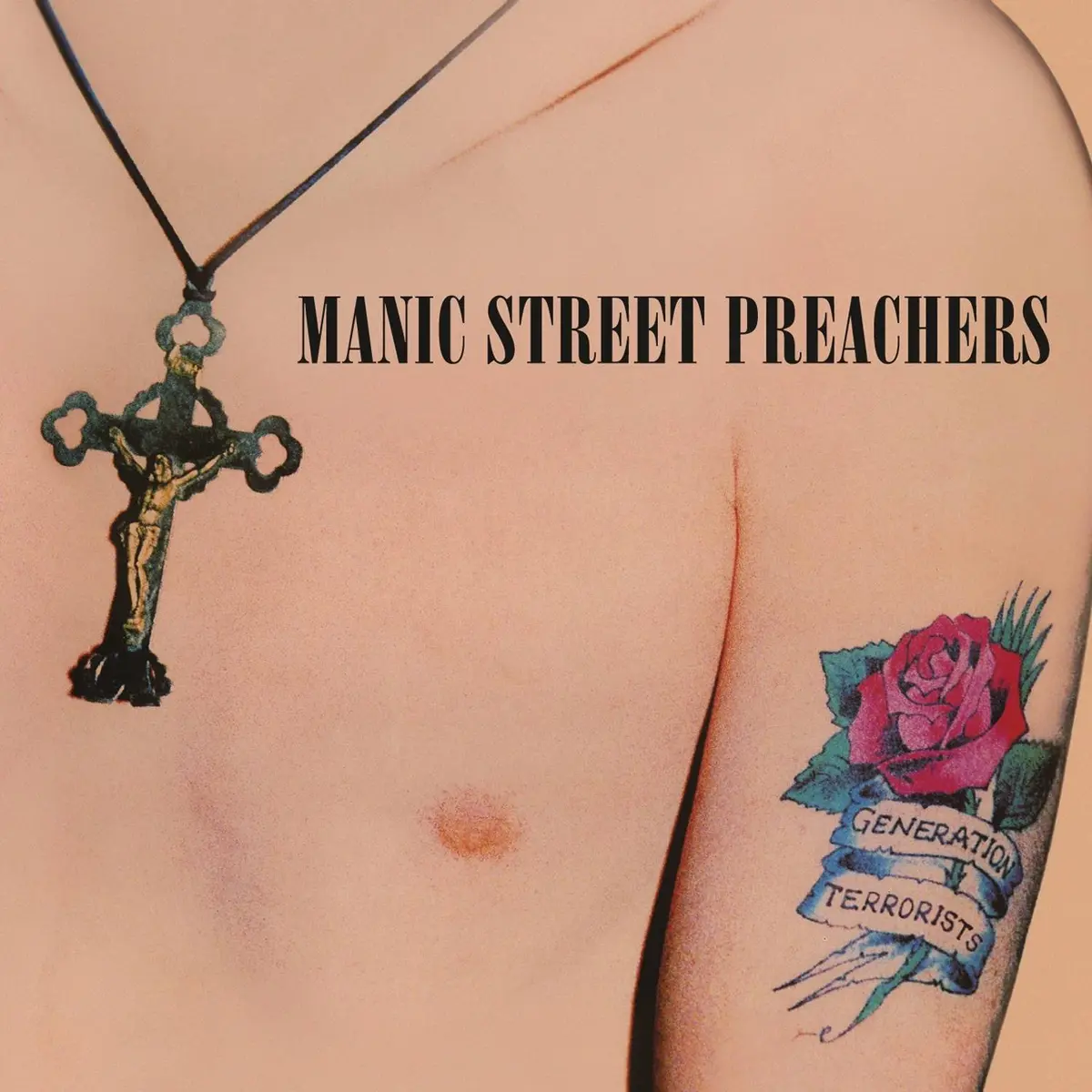
It’s 2004. I’m thirteen years old, watching VH2. A histrionic, wailing guitar line heralds four young men, stood unmoving amid a sea of fast-forwarded, umbrella-wielding pedestrians on a neon-drenched street. We briefly cut to a close-up of one of the quartet, effortlessly cool with his pinstriped suit and five o’clock shadow, before he is obscured by another graphic:
MANIC STREET PREACHERS
‘MOTORCYCLE EMPTINESS’
GENERATION TERRORISTS (1992)
1. SLASH N’ BURN . . . 3.53
“Progress is a comfortable disease”
E. E. Cummings
Subsequent tracks are accompanied by quotes from Larkin, Rimbaud, Plath, Camus, Orwell, Nietzsche and Burroughs, among others. By the end of the year, where possible, I will have bought and consumed all of the volumes from which these quotes originate, the pathway of my existence irrevocably shifted.
Given that Wales is a country often heralded as the land of song – its pastures a veritable assembly line for bards and lyrical wordsmiths alike – it stands to reason that the catalyst for my love of words would have to have been a Welsh band (and is there a better example of a highly literate group this side of the Atlantic than the Manics, whose signature song, ‘A Design for Life’, was inspired by the words that adorn the facade of Pillgwenlly Library?). It also feels somewhat apt that, this past August, myself, my co-editor Kathryn, and Issue 001 alumni Joe Dunthorne and Rachel Dawson found ourselves invited to the Green Man music festival in Brecon, to discuss the past, present and future of Anglo-Welsh writing.
As Folding Rock’s editors, this felt a landmark – a signifier of our growing embeddedness within the artistic culture of Wales and a chance to spend time with some of its most eminent figures, including Huw Stephens and Jude Rogers. Jude – whose 2022 book, The Sound of Being Human: How Music Shapes Our Lives, I adored – was a particularly coveted encounter, and I’m delighted to open this third issue with her sublime essay on CMAT and turning to music as ‘a gloomy, magnetic, unhelpful friend’ in difficult times.
It’s worth mentioning here that we had no idea what this issue’s theme of music – less abstract than the last two – would inspire. So it was to our pleasant surprise, as we commissioned, selected and edited the pieces that fill these pages, that obvious parallels emerged and reappeared like melodic refrains, irrespective of authorial intent or origin. For instance, Jude’s exploration of the life-affirming reverberations of CMAT’s lyrics meets a twin in Gosia Buzzanca’s remarkable essay on fangirlism, particularly with regard to the cultural behemoth that is Taylor Swift and her record-breaking Eras Tour. But it is the bildungsroman element of Gosia’s work that is similarly evident in ‘Blanket Island’. This by-turns nostalgic and sobering insight into music as refuge – in 1980s Birmingham – marks an exceptional first entrance by working-class writer Mel Eagles.
Meanwhile, Gosia and Jude’s mutual zeal for the almost congregational live performances of CMAT and Swift have a keen bedfellow in the short fiction of Mishima Yukio Prize winner Natsuki Koyata, who I’m proud to say is published into English for the first time within these pages (deftly translated from the Japanese by the talented Arthur Reiji Morris). Here, however, it is the dingy clubs of Tokyo (where the Manics filmed parts of the very same video I earlier described) and the pastoral hills of Niigata Prefecture that serve as the setting for Koyata-san’s exploration of live music’s power.
And then there is the extraordinary pair of courageous essays from the rising star Sophie Calon and another unpublished gem in Cadi Cliff. Both authors’ shattering depictions of the immediacy and the aftermath of their brothers’ deaths explore a very different kind of music, and get to the heart of something deeply human in the process.
These, alongside the remaining superlative pieces that make up this issue, offer but a fragment of the undersong that thrums through contemporary Anglo-Welsh writing. But what a fragment it is – rich, lyrical, sonorous and evocative, these are the choicest notes. We hope they’re to your liking.
The music of bands and artists – songs, lyrics, albums, performances – has clearly shaped the worlds and words of these writers indelibly, proving that great art speaks across boundaries of form, as I myself discovered some twenty-one years ago. May Issue 003 of Folding Rock grant you the same privilege.
Next up: folklore (sorry, Gosia – not a Taylor Swift reference!).
—Robert Harries, October 2025

Fiction and Production Editor
Rob is an editor and designer from Swansea, south Wales. In over a decade in publishing, he has worked both in-house and freelance for several London-based houses and the acclaimed Welsh independent press Parthian Books. During his career, Rob has edited titles by a wide range of authors, including the Booker Prize-nominated Stevie Davies, the music and comedy icon Max Boyce, the million-selling Richard Zimler and, most recently, the 2024 Dylan Thomas Prize-shortlisted Joshua Jones. Aside from editorial, Rob is also a book cover designer, as well as a budding audio and mixing engineer.
Rob takes the lead on fiction for Folding Rock, as well as managing our shiny new website, overseeing production, and doing lots of our design too.