Skip to content
‘Then they took the flowers of the oak, and the flowers of the broom, and the flowers of the meadowsweet, and from those they conjured up the fairest and most beautiful maiden that anyone had ever seen.’1 She is called Blodeuwedd, and she was created for Lleu, who was cursed by his mother to never have a wife from all the women who were on the earth at that time.

It’s 2018 and I’m in the gallery at the Ceredigion Museum in Aberystwyth. I’m looking at a painting of Blodeuwedd, titled ‘Face of Flowers’. She is walking forwards at an angle, first as a loose gathering of blossoms, creamy clouds of meadowsweet massing together to form her body, tumbling tresses of oak catkins above. Then she appears again as a naked woman. Towering above her is the cloaked figure of an old man with a wand, his hands raised like a puppeteer, and ahead of her another pair of hands wielding a wand. Around her is a white aura, the spell that contains and transforms her. Her feet point to one corner of the picture, and her eyes look to the other, as if she’s already seeking an escape.
This is the opening day of the Margaret Jones 100 Exhibition, a celebration of the artist’s one hundredth birthday. Margaret Jones illustrated the 1985 book Tales from the Mabinogion by Gwyn Thomas and Kevin Crossley-Holland, my first introduction to the story of Blodeuwedd. She is a character who appears in the medieval Welsh tale called ‘The Fourth Branch’, one of eleven such stories that are written down in two manuscripts, the White Book of Rhydderch (circa 1350) and the Red Book of Hergest (between 1382 and circa 1410), now commonly known together as the Mabinogion.
In truth, I didn’t intend to be here, didn’t even know this was happening. I’m taking part in a writing workshop and I’m supposed to be finding museum exhibits to spark ideas. Instead, I’m subsumed by memories, a child again, escaping into stories, daydreams, other worlds of magic and myth – where I’m not being reprimanded for daydreaming or failing to hand in homework, or teased for the way I dress and speak.
As a child I was obsessed with myths and legends. I devoured the books of Roger Lancelyn Green, Mary Stewart’s Arthurian series, Diana L. Paxson, Marion Zimmer Bradley, and of course Tales from the Mabinogion with Margaret Jones’ glorious illustrations. There has been much re-imagining and retelling of Greek and Norse myths over the years, but the stories in the Mabinogion have remained relatively unknown. Although, as Anna Fiteni writes, ‘[t]oo many romantasy novels fail to acknowledge or interrogate their Welsh influences.’2 They are there, but not in plain sight. ‘It feels like Wales is everywhere in romantasy fiction – or rather, the ghost of Wales is everywhere.’3
In her introduction to New Stories from the Mabinogion, the series commissioned and published by Seren Books in 2010, Penny Thomas writes: ‘[s]ome stories, it seems, just keep on going. Whatever you do to them, the words are still whispered abroad, a whistle in the reeds, a bird’s song in your ear.’4
The books explored in this essay all draw on the same myth from the Mabinogion, ‘The Fourth Branch’, which begins with the brothers, Gwydion and Gilfaethwy, executing a plan to isolate and rape Goewin, the virgin footholder of their uncle, the powerful wizard Math. Math marries Goewin and punishes the brothers, but he needs a new footholder, so Gwydion proposes his sister Arianrhod, who is publicly humiliated when it is discovered she is not a virgin. She curses her illegitimate son, Lleu Llaw Gyffes, to never have a wife of all the women in the world, so between them Math and Gwydion create a woman out of flowers and magic, Blodeuwedd, but she falls in love with another man (Gronw Pebr). Between them, they kill Lleu, but he is found and resurrected by Gwydion, and Blodeuwedd is transformed into an owl as her punishment.
One story. Three authors. Three dramatically different novels.
That’s the beauty of working with myth and fairy tale. The writer can choose between an epic retelling with all the events and characters, or pick one minor player and tell their story. They can choose a completely different setting, play with genre, swap the roles of protagonist and antagonist. The possibilities are intoxicating. Despite drawing from the same well, these three novels tell their own tales, speaking from their own distinctive contexts.
Another consideration here is the nature of retelling, and how each one influences those that come after, as indeed the surviving manuscripts containing these stories were undoubtedly influenced by what came before. After all, what many people assume to be the original is merely the first written version, and is likely only one of many oral iterations, each spun a little differently depending on the teller, the audience, the place and the time.
The Owl Service by Alan Garner was the first novel I read that was actually set in Wales with Welsh characters. Not only that, I had already read ‘The Fourth Branch’ in my copy of Tales from the Mabinogion, so it was thrilling to find some connection there, as well as to read a book with the same physical and cultural landscape in which I lived.
Though first published in 1967, the copy I have now was released by HarperCollins in 2023 and features a new introduction by Philip Pullman, who remembers how, in the late sixties, fantasy was looked down upon with scorn by the academic community. But as a young man reading English at Oxford, he recalls ‘the sensation it caused . . . among those of us who had arrived at university with our heads already harbouring an unhealthy fascination with hobbits and elves and so on.’5
Unlike Tolkien’s writing, The Owl Service could be described as low fantasy: a real-world setting disrupted by mythological characters and fantastical happenings. In his postscript to the book, Garner describes it as ‘a kind of ghost story’, but were it published now it would likely be branded as folk horror – which says more about changes in marketing terms than about the book itself.
The characters are haunted by the tragic figures of myth, Lleu Llaw Gyffes, Gronw Pebr, and of course Blodeuwedd, doomed to re-enact their story over and over. This time, it’s three teenagers stuck together in a remote valley over the summer holidays. Alison, her new stepbrother Roger, and Gwyn, son of the housekeeper. Odd noises in the attic above Alison’s room lead them to investigate, but all they find is a dusty dinner service with a floral pattern. Alison becomes obsessed with tracing the flower pattern and re-shaping it into owls, unknowingly repeating Blodeuwedd’s punishment, over and over.
On re-reading this as an adult (and a writer), I’m struck by how much of it is dialogue, and how well Garner writes it. Fast-paced and sharp-witted, it carries much of the story, and you would not be wrong in thinking this would make it ideal for a screenplay. Indeed, Granada adapted it for ITV in 1969, the first all-colour, all-film scripted serial, and I managed to track it down on DVD so I could watch it. For me, it’s lost some of the magic of the book, but that could be because I’ve been spoiled by the 4K, HDR, big-screen, hyper-realistic film experience we’ve become used to. When this was first broadcast it would have been as engrossing and electrifying as the early seasons of Doctor Who. Perhaps we’ve lost some of that facility of the imagination to fill in the gaps in the scenery.
More to the point for me, the TV series lacks Garner’s prose. In the book it has the beauty and economy of poetry – scattered paragraphs between speech, or occasional lengthier sections, but like an Impressionist painting, the exact strokes needed to embody a moment:
the rain washed the air clean of her words and dissolved her haunted face, broke the dark line of her into webs that left no stain, and Gwyn watched for a while the unmarked place where she had been.
The landscape comes alive – another character in the drama that replays, over and over:
[t]here were no clouds, and the sky was drained white towards the sun [ . . . ] when he looked about him he felt that the trees and the rocks had never held such depth, and the line of the mountain made his heart shake.
The Owl Service is set around the village of Llanymawddwy, under the shadow of Cadair Idris, where Garner once stayed. I’ve driven through that valley a number of times and it’s easy to believe it’s haunted. You could describe it as a thin place, somewhere history and myth feel almost close enough to touch. Garner himself talks about ‘[t]he sensation of finding, not inventing a story’, likening himself to ‘an archaeologist picking away the earth to reveal the bones.’
Something else he brings to the story is a keen observation of social structure. Although young, the characters are already divided by class; ordinarily Alison and Roger would be unlikely to ever encounter Gwyn, the working-class son of a single mother. Not just that, but he’s the son of the housekeeper and not much more than a servant. At one point Roger says it outright: ‘he’s not one of us and he never will be . . . that’s all there is to it.’
Published in the sixties, the novel is of its time in the depiction of clear divisions between classes, and the desire of Gwyn’s mother, Nancy, that Gwyn not speak Welsh, considering it to be a disadvantage. Alison, Gwyn and Roger are trapped in their social roles in much the same way as the spirits of Blodeuwedd, Lleu and Gronw are doomed to repeat their story.
From a rural working-class background himself, and a student of classics at Magdalen College, Oxford, Garner himself would likely have been familiar with these issues. The characters in The Owl Service express this conflict, especially Gwyn, both of the valley and not, connected to the place and culture but looking outward.
It should be noted that the sixties were also a time of unprecedented freedom, and likewise, there is a sense of possibility at the end. A chance that this time could be different.
The new millennium brings us to The Meat Tree by Gwyneth Lewis, published in 2010 but set 200 years later in 2210. It’s a million miles from the small world of Garner’s remote Welsh valley, and yet it’s even more claustrophobic. The setting is a spaceship orbiting a future Mars colonised by humans. It’s written in the form of journal entries and recorded conversations by the two characters: Campion, an archaeologist on the verge of retirement, and Nona, a young student on a work placement. The novel opens with their cataloguing of an old spaceship. In an attempt to find out what happened to the crew, they try out the antiquated VR equipment and find themselves immersed in the mythological world of the Mabinogion.
Gross physicality is at war with intellect: the VR story is addictive, all consuming, and academic detachment becomes increasingly difficult as both characters find themselves subsumed. ‘Mind of the body, as the lichen lays in the moss and the tree sucks sweet water up, like a tide . . . ’
Campion repeatedly attempts to analyse: ‘[y]ou see this a lot in late medieval mythology. The functions which previously belonged to the Goddess are taken over by men. Hence Gwydion’s male pregnancy,’ referring to the section where Gwydion and Gilfaethwy are transformed into male and female animals as punishment for the rape of Goewin, and later:
[a]s if the characters weren’t wholly differentiated from each other. That happens in the dreamlike early human myths . . . men turn into animals, siblings are lovers, wild animals are princes. All the categories bleed.
I can’t help feeling that there’s an element of meta-criticism here; Lewis seems to be analysing the myth as she writes, turning it over and over, looking from all angles, even having Campion say: ‘[i]f I were a literary critic . . .’ and going on to note the repetition of certain words. In the hands of a less experienced writer, I don’t think this would work, but Lewis pulls it off with panache. It’s worth mentioning here that she is also a renowned poet (the first to be appointed national poet of Wales in fact), and when Blodeuwedd speaks through Nona – ‘I’m a translator, a poet of the sun’ – she could be describing Lewis herself.
In The Meat Tree, Lewis gives Blodeuwedd a voice and a personality that is far more nuanced than in the source material, but also deeply alien. ‘I stretch, luxurious in the light, knowing that my intelligence is a web of filaments and filigrees, specialised in feeding on the tiniest amounts for the greatest results.’ And of course, being made of flowers ‘[s]he speaks in fragrances.’
The conflict between the intellectual and the physical, between academic and creative – is this a reflection of the author’s duality? Teacher and poet? As writers, no matter how much we analyse and how technically proficient we become, there comes a point where we must surrender to intuition. The wisdom of the body, perhaps. As they begin to lose control of the VR narrative, Nona remarks that ‘the body has a way of taking over the story.’ One without the other is not enough. Great writing comes from the marriage of intellect and instinct, and as someone who is clearly both academic and creative, Lewis knows this well.
The problem with retelling myths and fairy tales is that it’s been done many times before. There is a temptation to label certain versions iconic, and to accept them as canon, but I feel this misses the point. Before the literary fairy-tale tradition began with writers like Straparola and Basile, Perrault, the Brothers Grimm, stories were not attributed to any one person. But we can assume, based on how successive writers have spun their own versions, that oral storytellers did much the same thing, and that is something that can and should continue. Every teller can add something, giving us a rich and varied tradition that is for everyone. Debut novelist Brigid Lowe does just that in her epic retelling of ‘The Fourth Branch’, published this year by Harvill.
The Bloody Branch is a medieval fantasy in the tradition of writers like Diana L. Paxson and Marion Zimmer Bradley, a retelling set in the mythical past of the source material, but bringing the perspectives of the female characters to the fore.
This is an unashamedly feminist interpretation. You will grow to hate the wizard Gwydion well before the final page, and with good reason. Lowe does not shy away from the darker subjects, describing with unflinching detail the sordid parade of violence, coercion and rape inflicted upon the three female narrators: Goewin, Arianrhod and Blodeuwedd. Each in turn, they tell their versions of the story to an unnamed traveller, evoking the spirit of the Welsh oral storytelling tradition. Lowe plunges headlong into the mythical world of the Mabinogion, where magic is an accepted part of life, but in places where the source material often skims over the details, she fills them in with a verbosity that is at times reminiscent of the baroque excess of Angela Carter.

The novel opens with Goewin, telling the story of how she became Math’s footholder. She speaks of her home, the island of Ynys Môn, and the difficulty of giving up her freedom. In the source material Goewin has no voice, and she is in fact little more than a plot device to advance the men’s tale of trickery and war. Lowe inverts this by making her the first narrator, bringing her to fully rounded life with loving detail. The world from Goewin’s perspective is small to begin with. Unless Math goes to war, he is cursed, obliged to have his feet rest on the lap of a virgin. Goewin describes Math’s old-man feet: ‘[t]he skin of his arches was fine as crepe silk, with shining violet scars, but the nails were curled and yellow, the soles thick and cracked as a griddle cake.’
Arianrhod’s voice comes in with the memories of first meeting her half-brother Gwydion, and his attachment to her that soon metamorphoses into jealousy and obsession. She continues her pursuit of knowledge, fiercely maintaining her autonomy despite his attempts to possess her and, that proving impossible, to punish her.
Finally, Blodeuwedd, with all of the rage and confusion of something wild and untrammelled, bound into the shape of a woman to be used by Lleu:
[t]hey made my body of lilies, which they stroked with thick fingers as they fashioned its curves and lines to meet their wish. They placed bursting buds where it pleased them they should be and squeezed them to make sure that they were firm.
The three women pass the narrative between them, braiding their stories, giving voice to the trauma of rape, the combined joy and paranoia of motherhood, the inconsolable grief of losing a child, and that most unacceptable of emotions: female rage.
I was intrigued to find the story continuing past the point at which it ends in ‘The Fourth Branch’. In the acknowledgements section Lowe states that ‘the events of Part III can be found in the medieval sources of the bard Taliesin’s poem “Cad Goddeu” and the Peniarth manuscript 98B,’ and goes on to say, of the gaps and ‘events which lack explanation’, that she has ‘filled in the detail with other narratives taken from traditional songs and stories across the Celtic tradition’. The result is truly magical, and can be read purely as a straightforward (and beautifully written) fantasy novel, but it also functions as an accessible and well-informed exploration of the Welsh mythological landscape.

Lowe is clearly a conscientious and rigorous researcher, and that provides the underpinning for the text, but it’s her passion for the landscape and its flora and fauna that makes this novel shine. She is a lover of swimming and scrambling in the wild places of both Wales and Scotland, and this love is evident in the voices of her three narrators.
Lowe states:
I am proud to know, to repeat and to build on the traditional stories, metaphors and lore I heard sung and spoken in my childhood, and all the poetry and fiction of more book-bound and ‘literary’ culture which draws its influence from that folk tradition.
Alan Garner, Gwyneth Lewis, Brigid Lowe: all these authors have made valuable contributions to the living mythological tradition of Wales, and I hope other writers and artists will be inspired to do the same.
While wandering around the exhibition of her paintings in the Ceredigion museum, I was lucky enough to meet Margaret Jones herself. I can’t imagine there are many artists who get to attend their own centenary exhibition, and I remember her as bright and happy, mingling with the crowd, seeming much younger than her one hundred years.
I wanted to tell her how much her illustrations of Tales from the Mabinogion meant to me growing up, but when I tried to speak my voice caught in my throat and my eyes filled with tears. This welling up of emotion was entirely unexpected, brought up from some unhappy childhood place, and connecting to a present where I retell the stories myself. Gwyneth Lewis expresses this best in her afterword to The Meat Tree.
This is a conversation with other people and minds, even though those with whom we speak . . . aren’t physically present. This is a tree, after all, whose branches are still bearing fruit and on which new leaves can never feel lonely.
Perhaps those ‘other people and minds’ include our younger selves, listening out for the stories we reshape – for who we once were.
References
This piece first appeared in
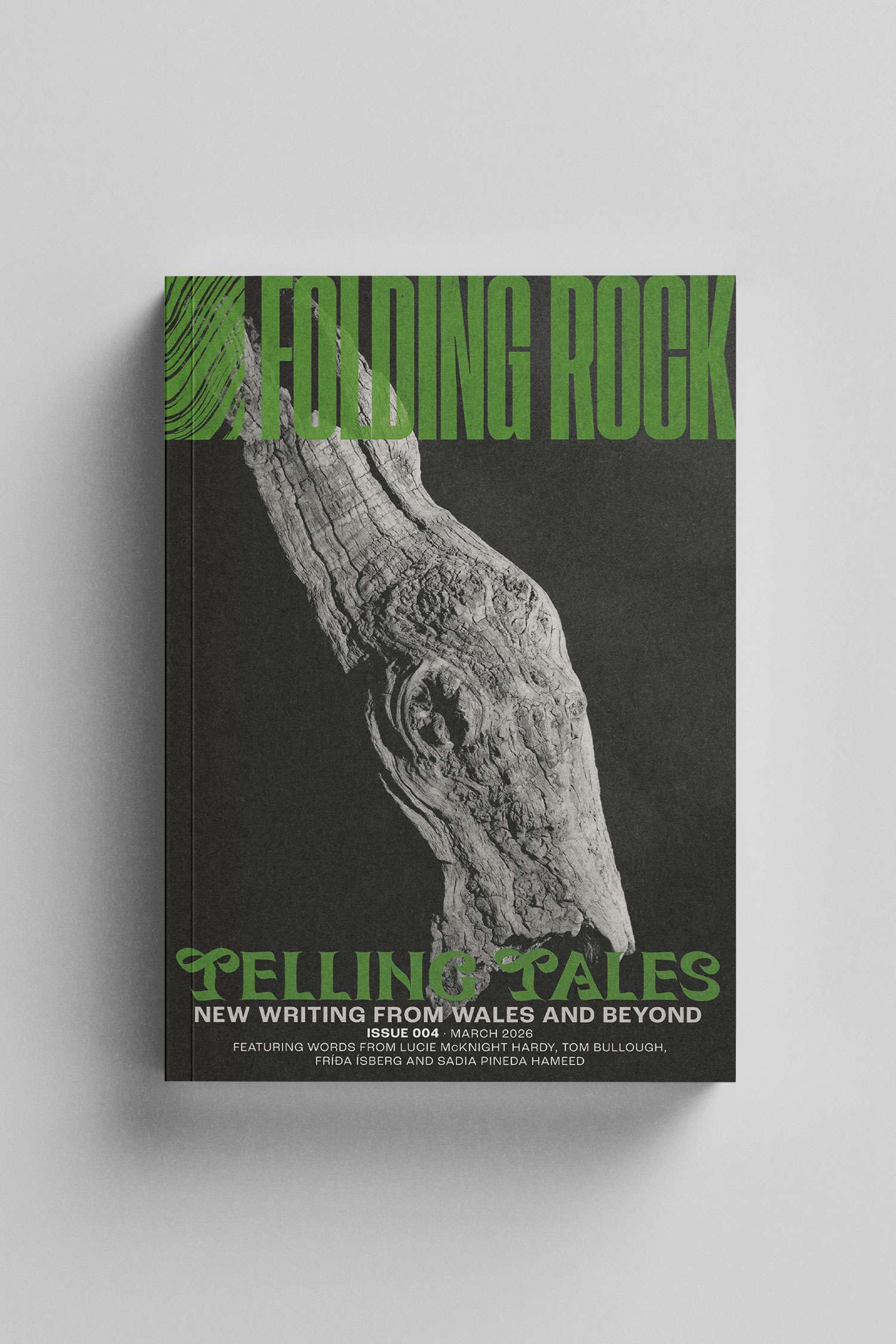
Featuring new work from writers including Lucie McKnight Hardy, Tom Bullough, Fríða Ísberg and Sadia Pineda Hameed
Time tells us that one story can branch into a great oak of different tales. Folklore, it seems, is tightly woven into our lives, our histories, and the way we understand the world – no matter where we come from. From Welsh chapels in the hills of Mizoram, to ancient stones on Yns Môn. From Icelandic shores to a lakeside in Yr Eryri. Hidden secrets, haunting losses, confessions, obsessions and transformations . . . Issue 004 spreads its boughs far further than the pages of the Mabinogion.
Rosy Adams is a poet and fiction writer from Powys. She was part of Literature Wales’ second cohort of Representing Wales writer development programme in 2022/23, which led her to set up a Community Interest Company to organise and fund on-going support for under-represented writers in Wales. She edited and contributed to (Un)common: Anthology of new Welsh Writing (Lucent Dreaming, 2024). Her writing has been published in The Lampeter Review, Lucent Dreaming Magazine, These Pages Sing, Gwyllion and Poetry Wales among others. She is in the final stages of a collection of contemporary short stories influenced by myth and fairytale, and she has a novel in development.