Skip to content
In this fascinating essay from Issue 004: Telling Tales, Lorcán Lovett uncovers the influence of Welsh missionaries in Mizoram, reflecting on belonging, faith and colonial legacy, with beautiful photography by Valeria Mongelli.
I met the painted gaze of a Welsh doll, her little stovepipe hat tipped toward a carved love spoon. In the glass cabinet, my reflection stared back too – biscuit mid-bite, tea in hand, sunk into a floral sofa, beside a rugby ball stamped with a red dragon.
‘The Welsh bungalow’s just outside,’ said our local host, Ruth Lalmuanpui, whose husband studied the Old Testament in Bangor.
We shuffled outside and, after climbing worn stone steps – always climbing here – reached a century-old timber home with pitched roof: the Welsh bungalow. Inside, a plaque listed pastors – the first five, until 1968, all Welsh.
Across the road, churchgoers sang hymns to the green hills, and as the sun slipped behind them, another chilly night settled in.
Cymru trinkets dusted homes across the town, though we were far from Wales – further, in fact, than a round trip from Cardiff to Timbuktu. Stumbling on unexpected bonds between my country and these highlands, I asked Ruth how I might dig deeper.
‘You should speak to Professor Madiki,’ she said, scribbling down the number of a theologian.
It was the next breadcrumb of half-forgotten history, trailing between Welsh graves and the last surviving missionary chapel. As Madiki would show us, this continent-spanning thread between two places was enduring, even tightening. Faulkner had proof here: the past wasn’t dead; it wasn’t even past – not in Mizoram.
While Mizo may know of Wales, few Welsh have heard of Mizoram. It’s in north-east India, a region of 45 million people known as the ‘Seven Sisters’ states, tethered to the rest of the country by a narrow strip of land called the Siliguri Corridor.
If China were ever to capture the corridor – the ‘chicken neck’ – peninsular India would be cut off from the Seven Sisters, a mosaic of ethnicities and languages wedged between the Himalayas and the arc of mountains along the Myanmar (or Burma) border.
Southernmost is Mizoram, a devoutly Christian state bordering Myanmar and Bangladesh. To reach it, we woke before the roosters and climbed into a rugged 4×4 – public transport dubbed the ‘sumo’, built for the steep, winding roads – driving from Assam’s plains, up and up, into a world where people look more South East Asian, and a place that feels, altogether, calmer.

Crammed inside a sumo, you get to know your fellow passengers fast, eyeing who’ll vomit first (there’s my reflection again). Once, two girls up front puked so constantly they kept their heads out the window the whole time, only ducking back in to demolish fried snacks from a plastic bag. Gross, yes, but impressive.
This time, a Mizo passenger asked where I was from.
‘Wales,’ I said, expecting . . . where’s that? Or the dreaded . . . in England?
Instead, her face lit up.
‘Everybody loves Wales here.’
Villages appeared like islands in seas of cloud. Our truck lurched between them, along verdant spines of land, flanked on either side by beige-dusted trees and steep plunges into bamboo valleys. Unlike the Hindu heartlands, roadside restaurants here served beef. We passed two Mizo nuns strolling by a jungle warfare school, its slogan hand-painted on the wall: Fight the guerrilla like a guerrilla.
The young woman nodded toward a church as we rattled past.
‘You brought us Christianity.’
At that, some Britons might feel an urge to apologise, not just because it’s a national default, but because the histories of missionaries are entangled with colonialism and cultural erasure. One Victorian evangelist to this very region wrote a biography titled Five Years in Unknown Jungles for God and Empire.
But the Welsh Presbyterians, who began arriving in the 1890s, are remembered fondly. They developed a written Mizo script, drove mass literacy and, above all for the Mizo, brought a faith that remains their bedrock. ‘Missionary Day’ is still a public holiday.
The British had been a political force in India for almost two centuries before annexing Mizoram. Known then as the Lushai Hills, it was decentralised, with little profit to extract; a wild frontier that the Mughals never took, and for years, the British seemed content to ignore too. Only after cycles of tribal raids and punitive expeditions did the Raj fully occupy this hinterland, though, unlike its earlier conquests of the subcontinent, missionaries were more prominent than merchants.
Next door, the Chin Hills, another sprawl of green heights, were folded into British Burma. The Mizo and Chin – kin within the broader Zo people – embraced Christianity. But their partition into different colonial administrations crystallised into a modern separation, with the India–Myanmar border cutting through what might have been a contiguous Zo homeland (an idea that has never fully gone away).
Yet borders have uses. If one state targets the Zo people, their neighbouring cousins open their doors, especially the Mizo capital, Aizawl, which some proudly call ‘Jerusalem’. Thousands of Chin now shelter there, their villages back in Myanmar reduced to rubble by military bombing.
I had come to this region to report on Myanmar’s pro-democracy resistance, formed after the 2021 military coup that sparked a civil war and has left at least 90,000 dead. We – the photographer Valeria Mongelli and I – wanted to tell the story of a Chin sniper who’d carved herself an elite reputation battling the dictatorship.
But access hinges on waiting, sometimes days or weeks, for a call from people who want witnesses to what the regime’s jets and drones are doing to them.
This time, though, there would be no hanging about in a state of mild anxiety. We could fill our boots with something unforeseen, something entirely different – the story of Cymru in Mizoram.
The spontaneity of it felt like being a cub reporter on patch again in Britain. I was also stunned, feeling so close to home in these far-flung mountains, tracing the crossovers of peoples; of the pious Welsh whose proselytism, carried out with such fervent efficacy, ensured their spirits would wander a Christian redoubt for centuries to come.
We’d already sidled into one church – a hulking concrete affair, the kind I imagine you’d find in the American Midwest – where an elderly Mizo pastor sat on the pew alongside us, searching the cupboards of his mind.
‘The first Welsh missionary?’ he said. ‘William Williams. He hoped to turn all the Mizo to Christians.’
That sounded suspiciously like the most Welsh name imaginable. But he was right. Williams was a ship captain’s son from Ceredigion who became a sailor, then a carpenter, then an evangelist, arriving in India in 1887.
A Mizo prisoner – captured in a British raid and jailed in what’s now Bangladesh – told Williams about his people: animists scattered in clans among the hills, tied to nature and spirits. They headhunted, and fought for land, cattle, honour.
In 1891, Williams sailed downriver toward Aizawl, at times escorted by imperial troops already present there. He met wandering Mizo boys, traded tobacco for yams, and then burst into hymn, while the boys watched, mouths agape.
After a month handing out biblical pictures and learning what he could, Williams returned north to the Khasi Hills and pleaded with the Calvinistic Methodist Church – later the Presbyterian Church of Wales – to extend their mission to the Lushai Hills.
By the time they agreed, he was dead: 21 April 1892, typhoid, aged thirty-three.
‘The Welsh missionaries decided that if one dies in Mizoram, another must take his place,’ the pastor told me. ‘So began the line.’
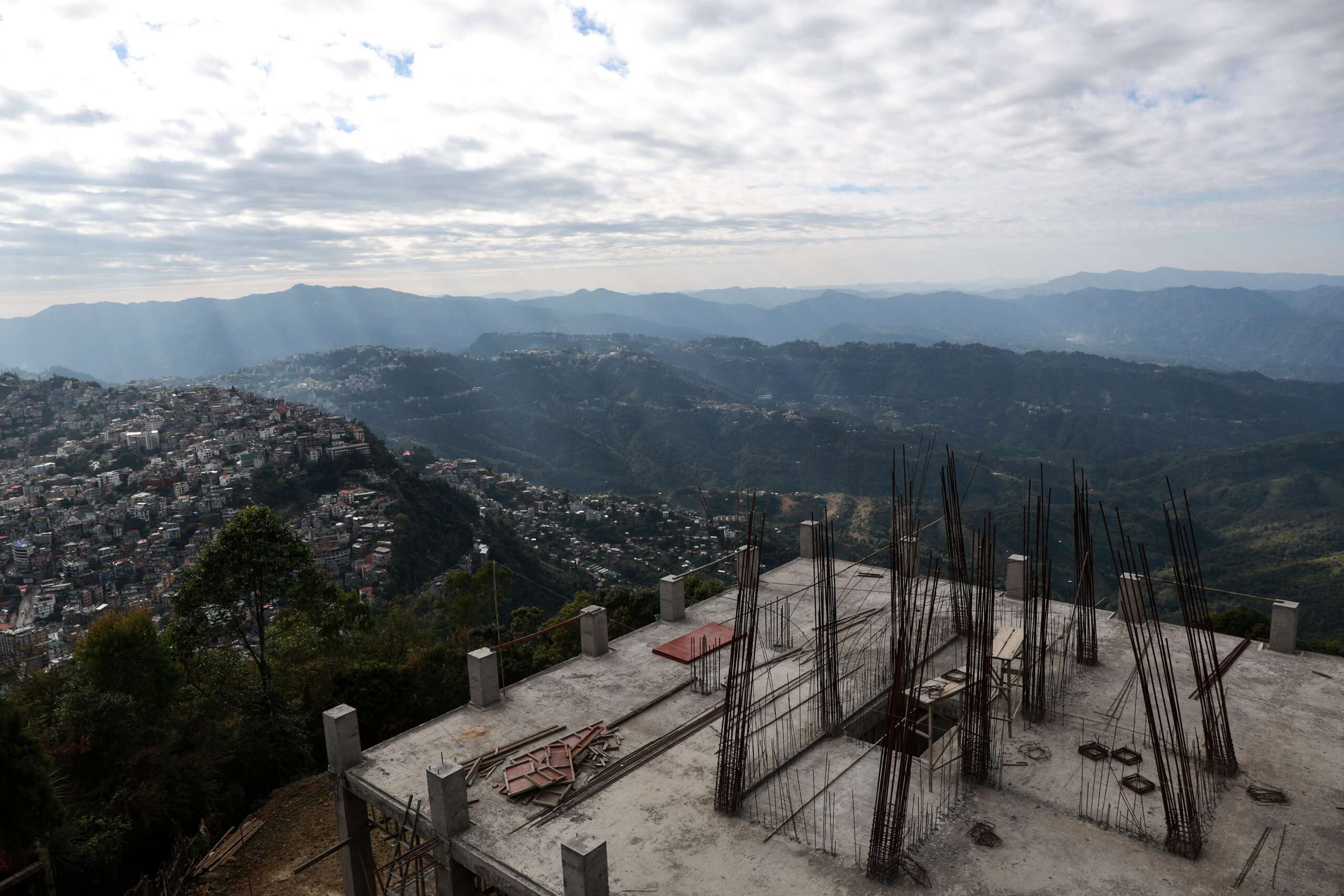
The next day, following Ruth’s advice, Valeria and I drove up to the theological college. A huge crucifix was under construction, rising above Aizawl, like a shield against the surge of Hindu nationalism on the mainland.
‘The moment we feel threatened, we jump to the church,’ said Madiki, a worldly professor, from her campus cottage. She was early middle-aged, youthful, with strands of silver in her dark hair.

She explained how Welsh missionaries, poorer than their Anglican counterparts in Calcutta, fostered an ethic of self-reliance that the Mizo absorbed readily.
‘They taught us to raise our own funds, to do things independently,’ she said. ‘That gave us autonomy, and the education they brought helped people adapt to change.’
Christianity and colonialism upended everything. Early converts, typically from the lower rungs of society, gained education, jobs and standing in the new order. Clan chiefs slipped down the ladder; within a generation, Christianity and colonial law had stamped out headhunting and intertribal wars, but barely spared Mizo heritage in the process.
The first Mizo believers, Madiki said, surpassed their teachers in piety, becoming ‘good Welsh Christians’ of the early 1900s, solemn and upright, while their pre-Christian culture was dismissed as backward or sinful. ‘A negative attitude toward our own heritage is still there,’ she said.
Although rice beer, Zû, had been central to Mizo life for centuries, even ‘dipping your finger in it was considered a sin to be disciplined’ during those times, she said. These days it’s hard – but not impossible – to wake up with a hangover in Mizoram. Alcohol remains heavily regulated, often attributed to Presbyterian influence, though Zû is resurfacing alongside a broader return to tradition.
Ironically, the door to reclaiming the old Mizo spirit would be opened by the same source of stuffiness that suppressed it.
The process began as far back as 1904 – a time when, in Wales, the visions of coal miner turned minister Evan Roberts inspired thousands to flock to the church in bursts of song and open repentance.
News of the great revival reached the Khasi Hills, whose Christians became equally ecstatic, drawing in Mizo delegates who returned to Aizawl in spiritual fervour. Some Mizo, enthralled in the rapturous Christian gatherings, danced and sang. If the buttoned-up Welsh missionaries objected, they had little ground; this passion was born in their own country and church – what Mizo call the ‘Mother Church’.
Mizo, who love singing as much as the Welsh, composed hymns in local melodies, and returned drums to worship. Christianity, now embracing Mizo tradition, was soon spread not by the Welsh, but by the Mizo themselves.
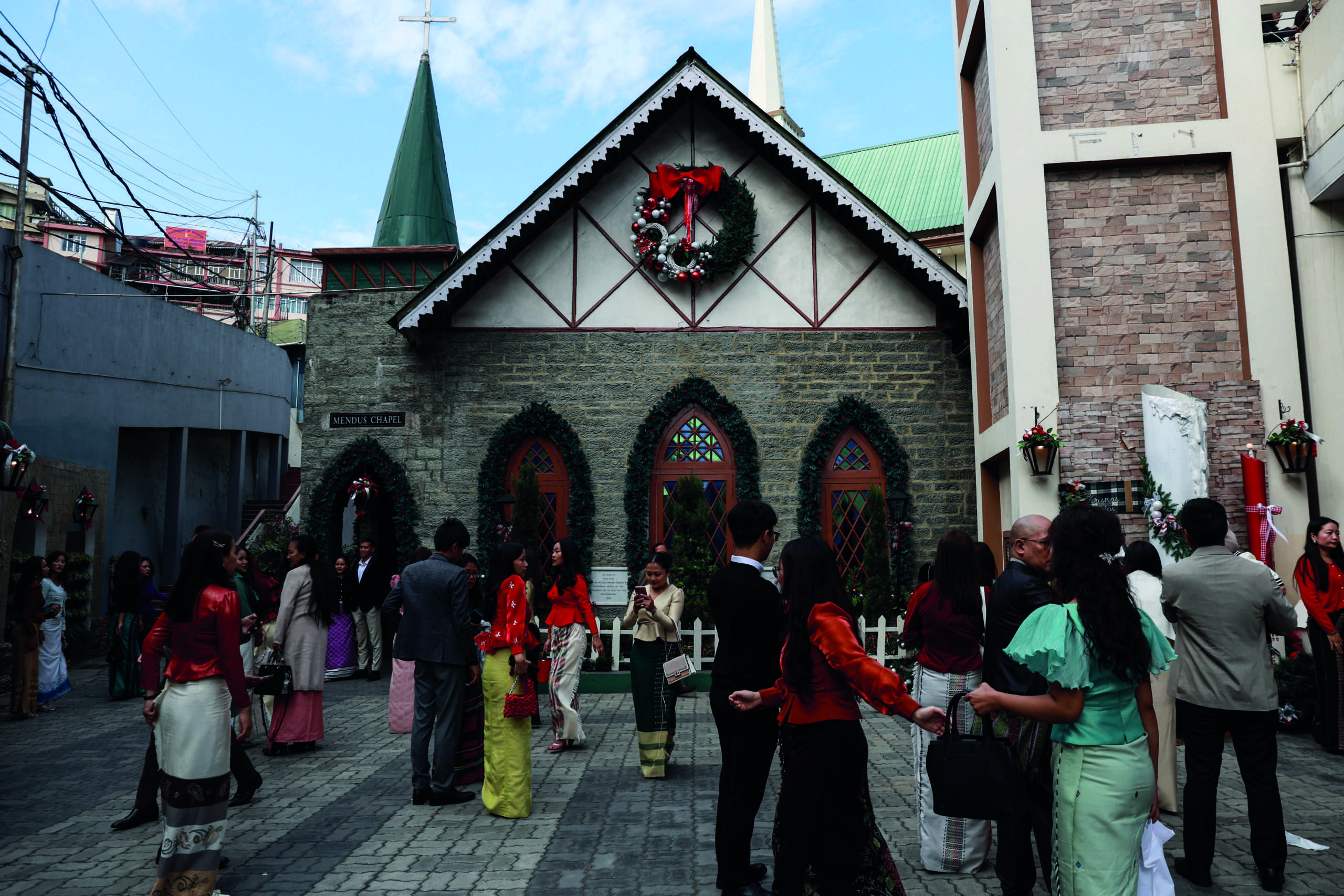
Only one missionary-era chapel remains today: Mendus Chapel, built Welsh village style in 1931, its beams fashioned from old railway iron. When we went looking for it in Aizawl’s city centre, all we could see was a two-storey church with a tall steeple. Surely the missionaries hadn’t built something this vast? Worshippers spilled out after a service, passing us pastries and sweet tea.
Then I noticed a donation plaque from a church in Aberystwyth on the stone wall of a small, squat rectangle in its shadow. We stepped inside – a plain, functional Protestant space. No frills, except for three sets of drums by the pulpit. A church elder stood by the window.
Two decades ago, there was a vote to demolish the place, he told us. Despite the chapel being too small for the congregation, they chose to keep it. ‘It’s very precious to us,’ he said.

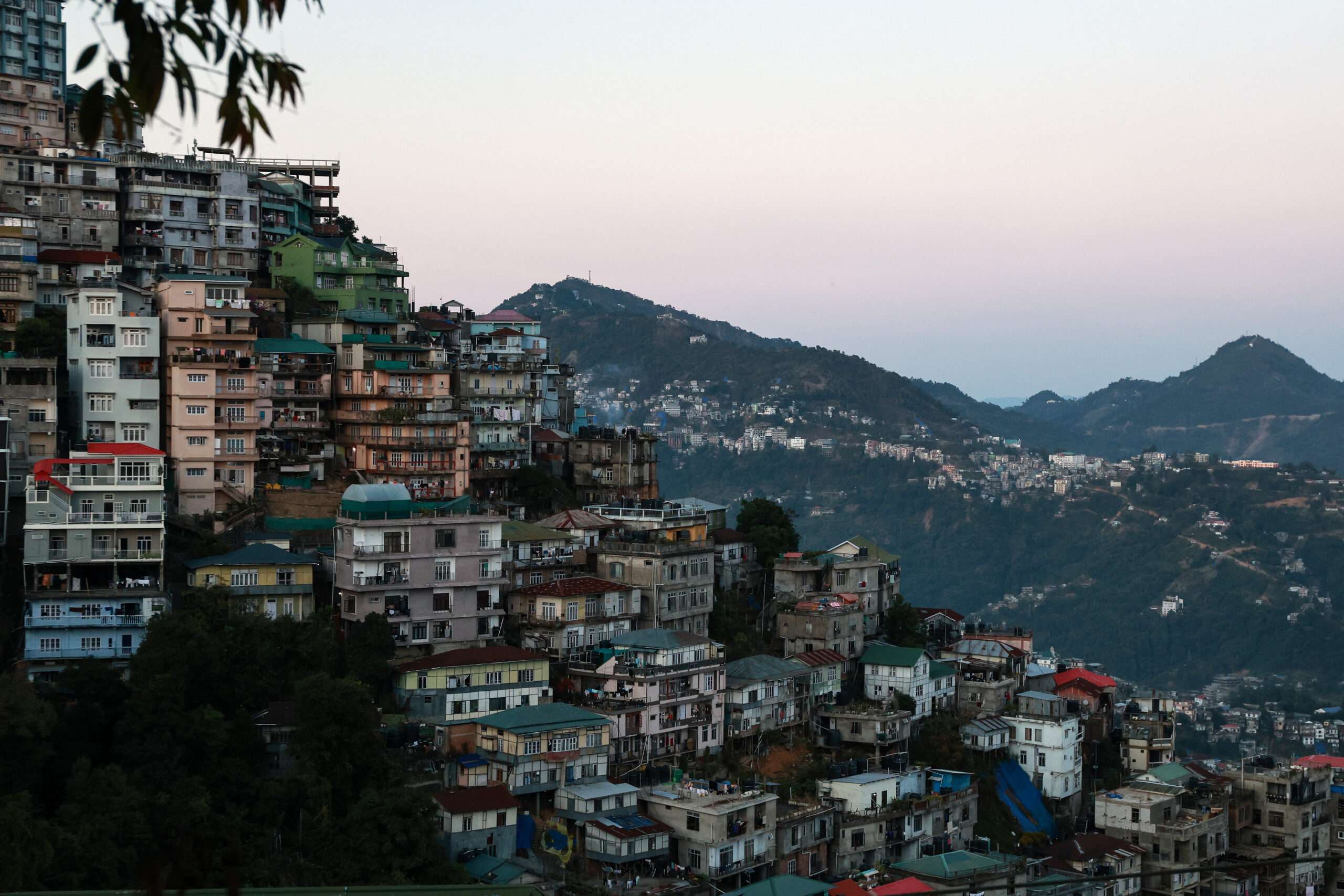
Aizawl spills down a mountainside into a deep green pocket. Ridges wall it, and, at night, house lights sparkle across the slopes, as if the sky has been tipped in. By day, children skip up calf-straining stairways that slice through the city. Little Maruti Suzuki taxis and scooters negotiate the helter-skelter streets, church spires shooting upwards. Stilted homes stack like bookshelves over sheer drops, and sound carries; the clatter of construction echoing across the pocket. Falcons sweep over the scene.
Madiki took us to three graves outside Durtlang Church. One belonged to Suakmichhinga Chawngthu, a local chief who died a Christian in 1953, aged eighty-five – old enough to have lived through the pre-missionary world, colonial rule and the dawn of independent India.
His neighbours were two Welsh missionaries. Catherine Evans, born in north Wales in 1872, and who died here in 1933. She shed abroad cheerfulness, read her epitaph. And Reverend Frederick J. Sandy, who arrived in 1914 and helped translate the Bible until his death twelve years later.
There were, until recently, missionaries still alive. Reverend Violet Louise Anne Mark, granddaughter of a Baptist missionary who came to southern Mizoram in 1907, died in November 2023, aged eighty-five. She stayed on in her grandfather’s bungalow long after the mission closed in 1977, married a local theologian and never left.
Madiki toured Wales for ten days in 2024. She met Margaret Jones, a 105-year-old former missionary turned illustrator of Welsh myths and legends, who spoke a few words of Mizo to her, and died shortly after.
Madiki travelled with her friend Reverend Rebecca Lalbiaksangi – the first woman ordained from Mizoram’s Presbyterian Church, though not in Mizoram. At home, their Mizo Synod has rejected proposals to ordain women pastors. Rebecca was ordained in Wales, where she now lives. Madiki would make an excellent minister – she preached twice in Wales – but as long as she remains in Mizoram, ordination is impossible.
‘We women theologists feel that the gospel, as it came to us from the missionaries, fed into the existing patriarchy,’ Madiki told us. ‘In Mizo society nowadays, government and business, women have equal opportunity. It’s only the church where that doesn’t happen.’
But, she suspects, if the church ever weakens in Mizoram, as it has in Wales, women ministers will be recognised to bolster the ranks.
As part of her pastoral charge, Reverend Rebecca looks after Brooks Chapel in Powys. The chapel was once under the care of Welsh missionary to Mizoram, Reverend David Evan Jones, who became known to the Mizo as Pu Zosaphluia after arriving in Aizawl in 1897. Rebecca has told local media she feels she’s completing a circle that began in Wales.
Meanwhile, there are even plans for a Welsh-language school in Mizoram, so Mizo ministers can proselytise in Welsh. Funding is a struggle; it might start as online classes, with the teacher in Wales and six to ten students in Mizoram. Then they hope it would evolve into Welsh people visiting Aizawl to learn Mizo and vice versa.
Plus, said Madiki, if Mizo learn Welsh, they can read the missionaries’ reports on Mizoram, thought to be archived at the National Library of Wales in Aberystwyth. ‘If you want to reclaim your history, the best thing is to know Welsh, so you can go and read it,’ she said.
I studied at Aberystwyth University, and for the first year, lived on the same corridor as a fluent Welsh speaker from the north. I’m from Swansea, where Welsh was taught once a fortnight to uninterested fourteen-year-olds – myself included – and I don’t speak it. It’s something I mean to change. In Mizoram, improbably, I felt more Welsh than I do at home, set beside fluent speakers, or in the Valleys, or the ‘more Welsh’ places. But that’s identity – shifting around those who are perceiving us.
We paint our own identities, carefully dabbing and blending out hues over the years, feathering with whisper-soft bristles. While everyone we meet creates their own version of that painting – a rougher sketch, the first flings of a Jackson Pollock. You do the same to them.
Mizoram’s identity, so distinct, guards itself jealously from the colossal presence of India. Madiki was stuck, between ethnic nationalism as a protector of heritage, and as a force for bigotry and hate. Mizoram had experienced its own potent tempers of blood and soil.
Every forty-eight years, a certain species of wild bamboo flowers, and its fruit attracts hordes of rats that sweep through the forests before devouring farmers’ crops, eliciting nightmares of famine. In 1959, central authorities responded with perceived indifference to the disaster, and a Mizo insurgency brewed. Calls for independence spread, and in 1966, Mizo nationalists captured military garrisons and the Indian Air Force bombed Aizawl. Twenty years later, a peace deal turned insurgents into politicians. Many suffered, and though independence never came, Mizoram, in the long term, prevailed.
Myanmar has found no such solace. After four years living there, the question of ethnic identity rattled around my head. What makes it? In eastern Myanmar, for instance, the Karen people have their own melodic languages, their own traditional clothes, like homespun cotton tunics paired with sleeveless shirts. Drums are integral to their rural life as well, emblematic in the bronze drum on the Karen flag. These drums, adorned with frog motifs symbolising Karen unity, were displays of wealth and status, but also conduits to the spiritual realm, their thuds propitiating forest spirits. Of course, there’s much more to Karen identity than a penchant for drums and frogs. So what is it?
I turn the question inward: What am I? Welsh. Or Cymry. Or Welsh–Irish. Or British. What does that actually mean? Identities within Britain blur and shift. Though London-born, poet Robert Graves claimed Wales as his spiritual home; childhood summers spent there steeped him in Celtic mythology that would inspire his work, while his service with the Royal Welch Fusiliers in the First World War provided the material for his masterpiece, Goodbye to All That. When the Second World War erupted, Graves pressed his son David to follow his Welsh loyalties and enlist with the same regiment – which he did. In 1943, David was killed, attacking a Japanese bunker in Myanmar.
Each one of Myanmar’s many ethnicities celebrates their own traditions, enchants their children with their own distinct mythologies. These expressions of identity take on intense meaning because a central power tries to suppress or erase or caricaturise them, forcing another identity in their place. Yet far from extinguishing their identity, these impositions inflame the desire to break free, and what follows is war – one that has persisted almost since the Japanese defeat, with the military’s 2021 coup dousing its enduring flames with petrol.
The Welsh missionaries of Mizoram had departed, but memories lingered. Madiki led us to a doctor who, as a boy in the 1940s, played alongside the children of illustrator Margaret Jones and her husband Basil in Mission Veng – Aizawl’s first missionary settlement.
Now eighty-five, Dr Ringluaia settled onto his sofa while his wife brought sponge cake.
‘I haven’t spoke English for many years,’ he said, the words returning quickly.
‘We used to see the Welsh people very often during my childhood. They were all tall, much bigger than the Mizo people, and they walked much faster,’ he laughed. ‘They spoke Mizo very well, especially their children.’
The church sponsored the doctor’s training in Wales from 1973 to 1975, on the condition that he return to Aizawl hospital. He worked at Nevill Hall Hospital in Abergavenny and Aberdare General Hospital. In Abergele, he visited another Welsh missionary’s children. ‘They were nice. But they’d all forgotten the Mizo language by that point.’
Church numbers in Wales were already declining then. ‘Most of the attendees were elderly,’ he recalled.
Today the Presbyterian Church of Wales claims just 13,000 members, a shadow of Evan Roberts’ revival days. The Synod in Mizoram has watched this collapse with concern. Like Reverend Rebecca, some Mizo now see it as their duty to reverse the Victorian missionary journey and reconvert the Welsh to Christianity. They also run yoga classes for the elderly and help out at youth clubs.
At Aizawl’s Synod office, where a harp gifted by a missionary’s child stood among other reminders of Wales, Reverend Z. John Colney, fifty-four, reflected on his twelve years in Ebbw Vale. The Mizo churches are the ‘daughters’ of the Welsh church, he explained, and ‘as the parents age, it’s the duty of the children to look after them.’
‘Wales is deep in our hearts,’ he said. ‘Not only the Christian community – the nation of Wales. We welcome everyone from Wales with a warm heart.’
‘We still hunt heads,’ he added with a smile, ‘but not with a knife. With the gospel.’
Then the call came for us to head closer to the border and return to the reason we’d come to Mizoram in the first place: to see what the Myanmar regime was doing to its people, and how those people were rising up against it.
Before we left, Madiki took us to a festive celebration at a church on Aizawl’s outskirts.
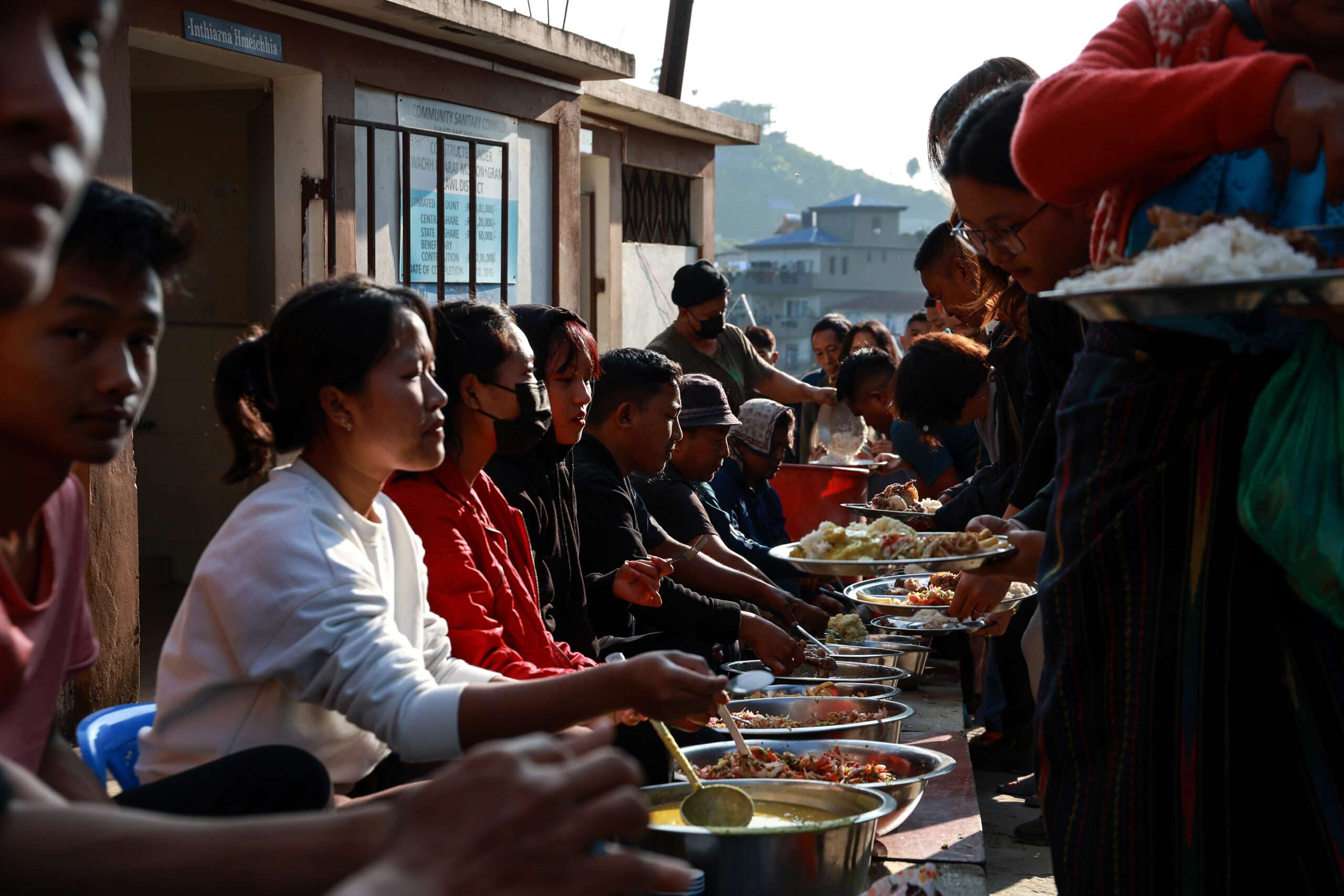
Vats of beef curry and chickpeas lined the walkway for a communal feast.
Mizoram is slowly changing, she said. ‘The outside world is very much influencing us now. People want more time for themselves and their families. The workload is higher, education is more competitive.’
By observing the Welsh church lose its relevance, ‘we see how changes come about, how we should respond,’ she said, and better prepare for their own challenges.
‘Because without knowing your history, you cannot understand the present and envisage the future,’ she said. ‘The church need not be so rigid or powerful anymore. Just a community where people can get healing and accepted. For me that’s enough.’
And then the service began: the drums began. Worshippers swayed towards the pulpit and swirled around together in a harmonious whirlpool. With their arms flung wide like falcons’ wings, they glided in a circle to the beat.


Lorcán Lovett is a Swansea-born journalist based in Southeast Asia. He has reported across Asia and Europe, with a focus on Myanmar since 2017. His work appears in The Guardian, The Observer, The Sunday Times and more, and he has featured on NPR, BBC Radio and other radio programmes and podcasts. His Myanmar reporting was shortlisted for the Kurt Schork Awards, and he writes the Substack newsletter On Myanmar.

Valeria Mongelli is an independent multimedia journalist based in Bangkok, Thailand. She has covered conflict and humanitarian crises in Europe, Asia, and the Middle East. Her reporting has appeared in The Guardian, Bloomberg, The Times, Der Spiegel, and El País, among others. In 2021, her coverage of the migrant crisis in the Mediterranean Sea was part of an Associated Press team nomination for the Pulitzer Prize. Valeria's work often centers on stories of women navigating war and resistance, with a focus on narratives that challenge dominant portrayals of conflict. Her photo documentary work is distributed by Hans Lucas photo agency.