Skip to content
Hay Festival Writer at Work Ben Huxley describes his debut collection of short stories, Cyberpunk Slums, launching (Un)Common literary magazine, the surrealism of Murakami and the role of chaos in his writing process.
Tell us about your writing life. When did it start? What does it look like now?
For as long as I can remember, I’ve been a daydreamer with a frantic imagination. This imagination first found an outlet in the primary school playground. My friend Ian and I would act out imagined scenes with our favourite video game characters; fan fiction meets improv theatre. Writing started soon after, and my first story was published when I was twelve. It featured a villain called Colin the Cannibal, and a twist I’m still proud of.
After an English Lit degree I lost a chunk of my twenties to parties, raves, retail jobs (to fund the parties and raves), and poor mental health. When student loans became available for master’s degrees, I rediscovered the same imaginative catharsis of the playground two decades earlier. As soon as I finished my MA, I was selected for the Representing Wales programme, and writing was cemented in both habit and identity.
What kind of writing excites you most?
As literary agents say, I don’t know what excites me until I’m reading it. From poetry to comics, if it has that magic quality then I’ll lose myself in it. But my favourite form is fiction; from gritty realism to surreal dreamscapes, the best fiction takes the chaos of culture, history, place, imagination, and the writer’s unique life – then, with words, blends them into a narrative that creates order and meaning. It really is magic.
What are you working on right now?
Right now I’m working on a collection of short stories called Cyberpunk Slums. Set in North Wales, these ten stories look at video games, the online sphere, and the virtual worlds of working-class life. “Cyberpunk Slums” is the name of one story, but the title sums up the whole collection. Something I noticed in the three years I worked in CEX is that poverty is rife, but virtual reality, artificial intelligence, and other tech that was previously secluded to science fiction is now ubiquitous. The cyberpunk genre has become reality.
From a young girl in school daydreaming about games, to a man in his thirties starting a gaming bar, to a surreal story of an elderly man blending his past with an online fantasy world. They’re an eclectic bunch of stories, in both style and content. I can’t wait to share them with the world.
Where do you write?
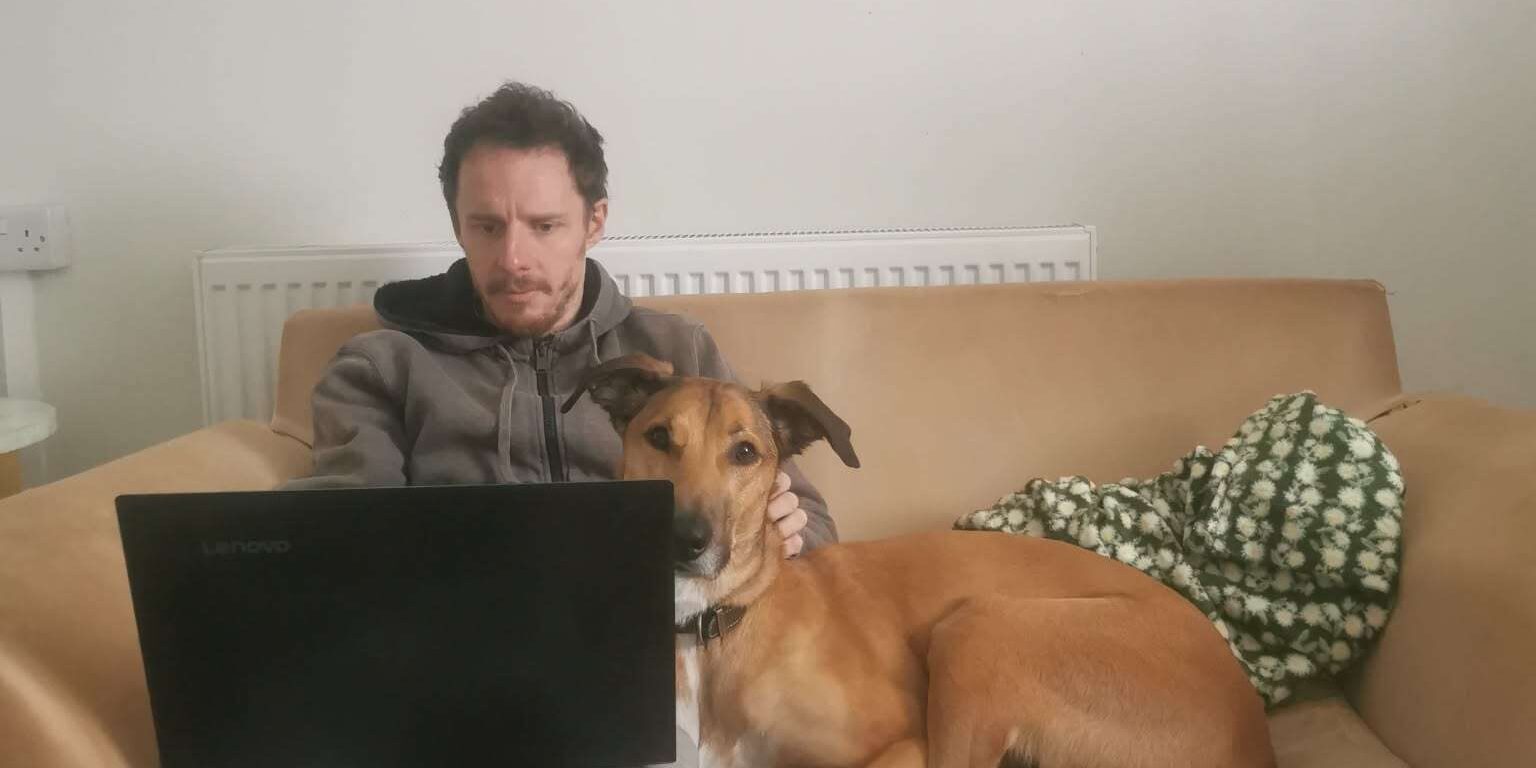
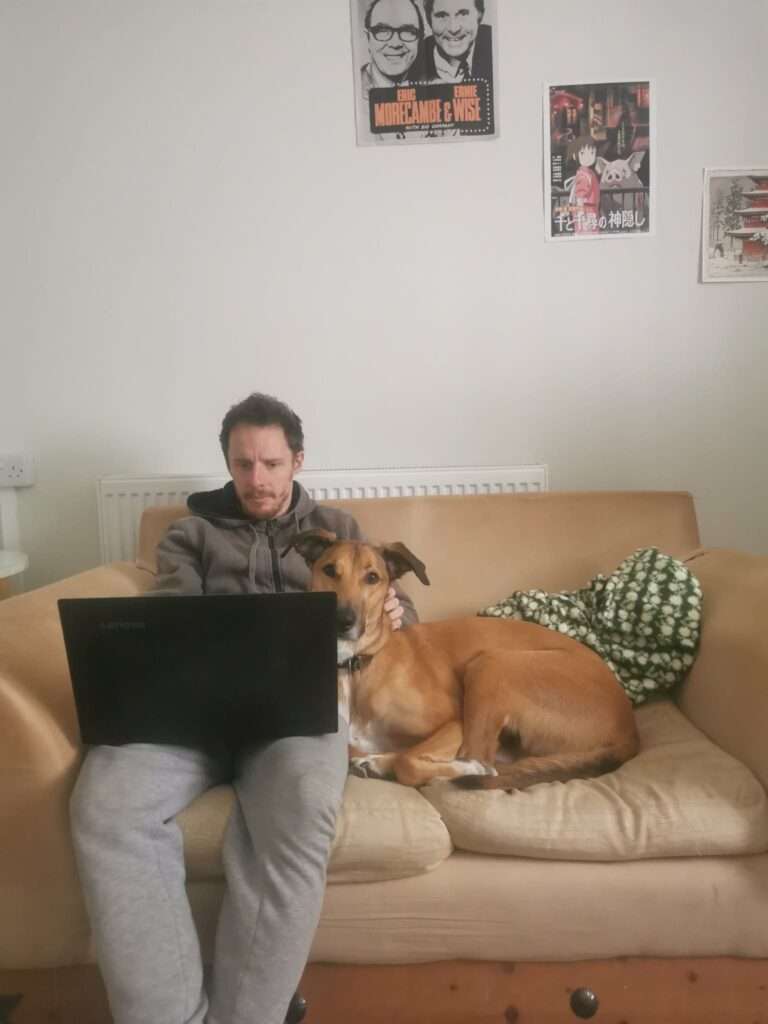
I love writing in cafés, but the noise situation has to be just right. Either very loud or very quiet (with perhaps some ambient music). If I can overhear a conversation then nothing will get done. So perhaps the safest place to write is at home in an armchair, my fiancé writing next to me, my dog asleep on the sofa.
When do you write?
I go through periods of strict timetable and structure, and periods of utter chaos. There isn’t a middle ground. But the writing always gets done and the resulting quality, I think, is the same.
And… Why do you write?
That frantic imagination I mentioned earlier needs an outlet, and there’s nothing as cathartic as words, sentences, paragraphs, pages. It’s a means of turning that scary internal turmoil into meaning and order. The real magic, though, is when someone reads my words and relates to them. It’s a form of communication and understanding that goes deeper than anything else.
‘Virtual reality, artificial intelligence, and other tech that was previously secluded to science fiction is now ubiquitous. The cyberpunk genre has become reality.’
Is there a book or author that has influenced you?
I’m going to be cheeky and pick two writers. When I was twenty-four I picked up Haruki Murakami’s The Wind-Up Bird Chronicle on a whim. By the time I’d finished it I wasn’t the same. It’s a surreal narrative that follows a dreamy logic, while diving deep into both Japan’s history and the protagonist’s mind. Murakami’s prose is so simple (at least, the English translations are) yet he captures the strangeness of the mind in a way that’s both terrifying and comforting.
The second writer that’s influenced me the most is my friend and mentor Niall Griffiths. His characters are familiar and relatable; lost, poor, addicted, searching for some kind of meaning. Yet through his lyrical prose and epic narratives, these normal people (Welsh, Scouse, Brummie) live tragedies as grand as anything Greek or Shakespearean. His works taught me that I can write about my own community without shying away from big ideas. Broken Ghost is the one I revisit most often.
And what role does reading play in your creative practice?
Reading is absolutely crucial in my creative practice. If I find myself uninspired, it’s probably because I’m not reading enough. And more important than reading, is rereading. I’ve read my favourite books countless times, in the same way my favourite songs have been played to death. It helps me get a deep knowledge of the rhythms and beats of a book, and I notice something new every time.
Tell us about something you are really proud of.
In my writing career, I’m very proud of the magazine that I’m launching this year with fellow writers Rosie Adams, Gemma June Howell, Alix Edwards, and Katrina Moinet. It’s called (Un)Common, and its aim is to give a platform to underrepresented and unpublished writers. We’re reading submissions for the first issue at the moment, and we’ve had some great stuff. It’s going to be really special.
What’s the best advice you’ve been given as a writer developing your practice?
Find joy in the process, not the result. You could say that about anything, not just writing, but I think it’s the most important. Also stay consistent, read often, find a community of writers, and take care of your physical and mental health.
There are so many ways to have a creative career. What would your life as a ‘working’ writer look like for you?
I wake up just before seven (beating my alarm), head downstairs, stretch, sit down with a few mindful breaths, then take the dog for a run on the field. After breakfast I sit at the computer with a coffee. I’m there for five hours (minus toilet breaks and trips to the kettle). At two, I save what I have (word count doesn’t matter, as long as it was five mindful hours). I go to the gym, Parkway Drive’s Deep Blue fuelling the reps and sets, then come home and shower. I play a game, watch a film, or read for a couple of hours, then cook tea for my partner. We discuss our respective days, then go for a walk on the prom as the sun sets. In bed, I get a good three of hours of reading done before drifting off.
That’s the dream, of course, but reality is far more chaotic. I would be over the moon to find a day job other than the retail and bar work that frazzles my neurodivergent brain. I made a decent amount from freelance journalism once, but that’s dwindling thanks to AI. If I could once again find rewarding work that’s writing adjacent; mentoring, running courses, editing – and that leaves me with time and energy to write – then I would be very happy.
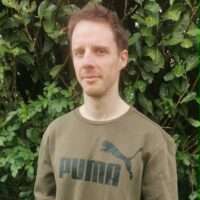
Ben Huxley is a writer from Colwyn Bay. His journalism and non-fiction have been published by Radio Times, The Escapist, TechRadar, Live Science, and WhatCulture. His fiction has been published by Lucent Dreaming. In 2022, shortly after finishing his MA in creative writing at Bangor, he was selected for Literature Wales’ Representing Wales programme. He will be a Hay Festival Writer at Work in 2026.