Skip to content
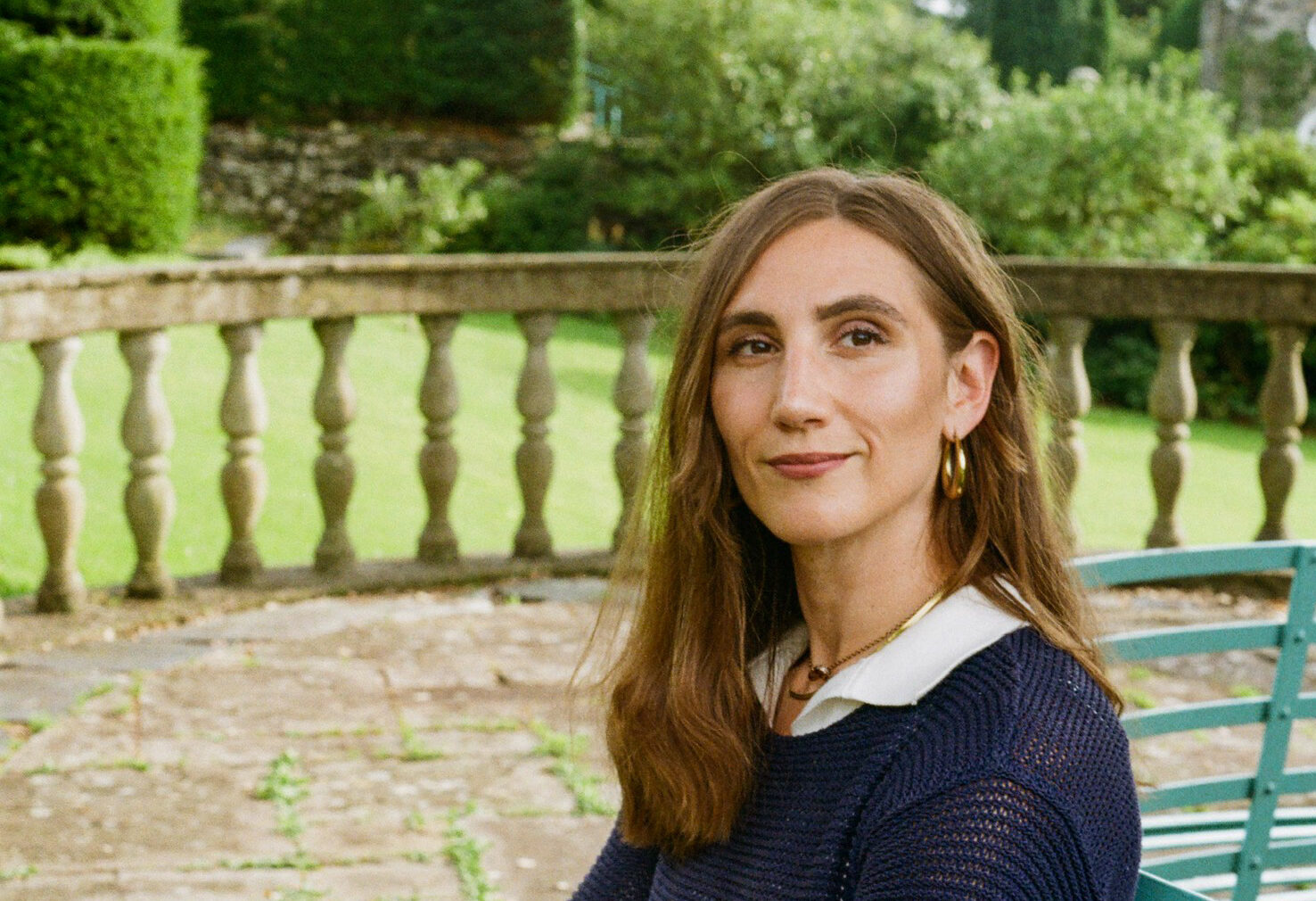
Writer and memoirist Silvia Rose walks us through her life in writing, from childhood dream diaries to the symbolism of the pomegranate, Granada to the peaks of Eryri, in the next instalment of our Hay Festival Writers at Work series.
Tell us about your writing life. When did it start? What does it look like now?
My love of words began with a book of nursery rhymes that I would obsessively recite, and whose hypnotic repetitions taught me how to read. I guarded secret notebooks with furry covers and cheap locks where I would transcribe adults’ conversations. I sent letters to pen pals and took the whole thing very seriously, keeping their replies in a big plastic folder, asking every child I met for their address. I sold handmade dream diaries in car boot sales and would write long, heartfelt messages in birthday cards, or frame poems as gifts.
Stories flowed from me instinctively. Coming from a split family, I learned early on the healing power of narrative, how it can stitch together disparities and make sense of a broken world. The written word was my truest, most direct form of expression. It felt like something solid and beating that I could safely share with others.
Going to a tiny rural primary school meant that as students we were given more hands-on attention, and I was always encouraged by my teacher to write. That nurturing environment was like being in a greenhouse: a hotbed mulch of positive regard that enabled me to take steady root and grow, supporting me to eventually move across the country to study Creative Writing at the University of East Anglia.
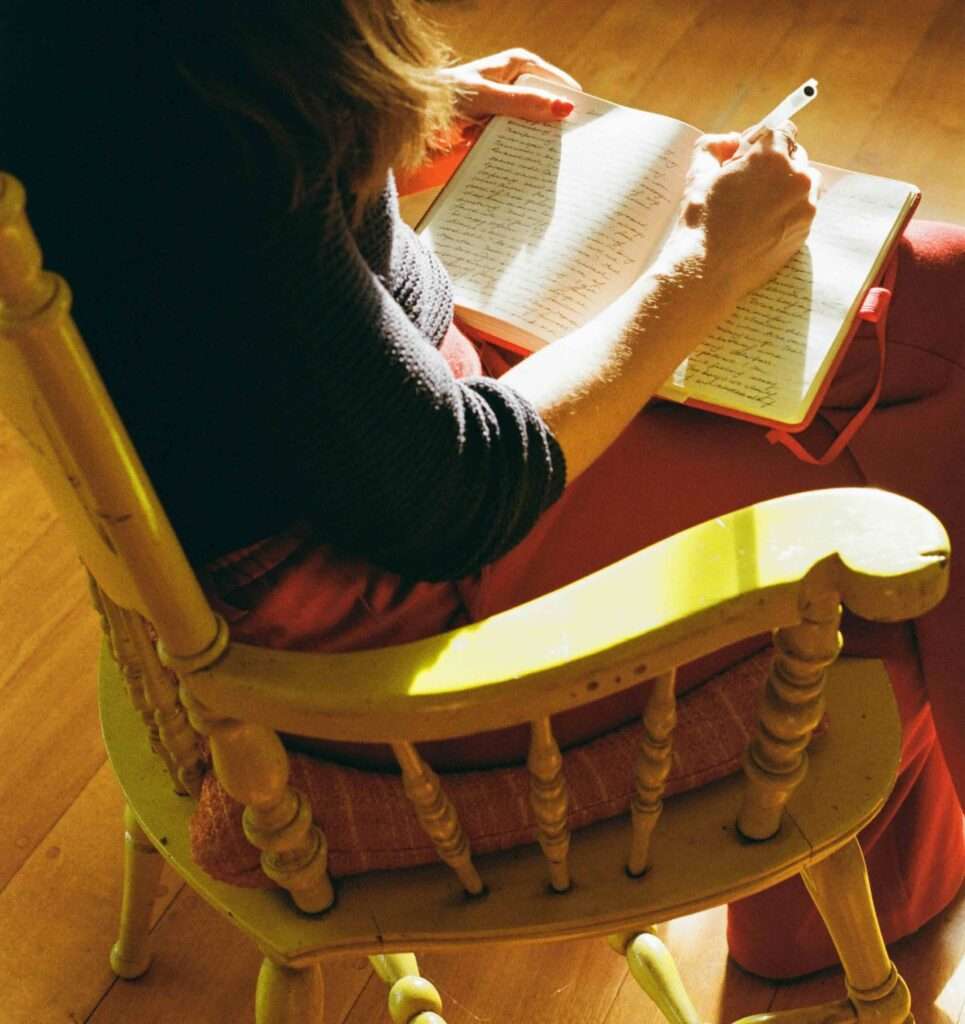
I’ve always kept journals and still have stacks of them from when I was ten years old. These time portals, these relics, are what I would save first in a fire. As a teenager I poured my most despairing, desperate longings onto the page. In my twenties they accompanied me on my travels, I mapped my inner and outer landscapes, marking spots of treasure with wild, frantic observations. I would free-write diligently and let my associative, dream-like mind take the reins, then sculpt poems from that raw clay material.
Now, in my thirties, writing is more consciously an act of distillation. Of getting to the very essence of a feeling, a place, or a dynamic. It has mutated and matured into a clearer focus; more riding the horse than horse being ridden.
What kind of writing excites you most?
I love writing that is specific, rich, dark and honest. I love writing that is full of concrete, meaty symbolism and skirts the edges of the surreal. I love the archetypal resonance of myth and fairytale transported into contemporary settings. I love writing that explores messy, complicated human relationships. I love flawed characters. I love gritty stories in glamorous locations. I love lots of breathing space on the page and sentences I can savour.
What are you working on right now?
I’ve recently finished a literary memoir called The City Bears Fruit, based on my time living in Granada, Spain and moving back home to the mountains of Eryri due to chronic fatigue. I’ve been working on it on and off for the last seven years, and it’s finally taken shape – helped largely by gaining a place on the last Representing Wales programme – and being mentored by the incredible Alys Conran. Having that dedicated time and support really helped tend to that flame of self belief that is so crucial when working on a longer piece.
The story is told in fragments and follows the life cycle of a pomegranate – Granada’s namesake – in sections from Seed to Bud to Flower to Fruit, then Ripening, Rotting and Replanting. Like Persephone, it’s a story of descent and transformation. It asks: what are the costs of living without boundaries, when we let the self dissolve into our surroundings?
In a way, it subverts the idea of hiraeth through the exploration of forced return; the reshaping of identity when we are torn between places and home is a medicine we might be resisting.
It’s been an interesting process as originally I intended to go down more of a fictional route, but the more I wrote the more I realised it had to be personal, even though I feel some fear and resistance around that. It’s exposing, excavating a time of your life in that way, but something I haven’t been able to avoid.
This book has really pushed its way out into the world and I’m excited to find it a home.
Where do you write?
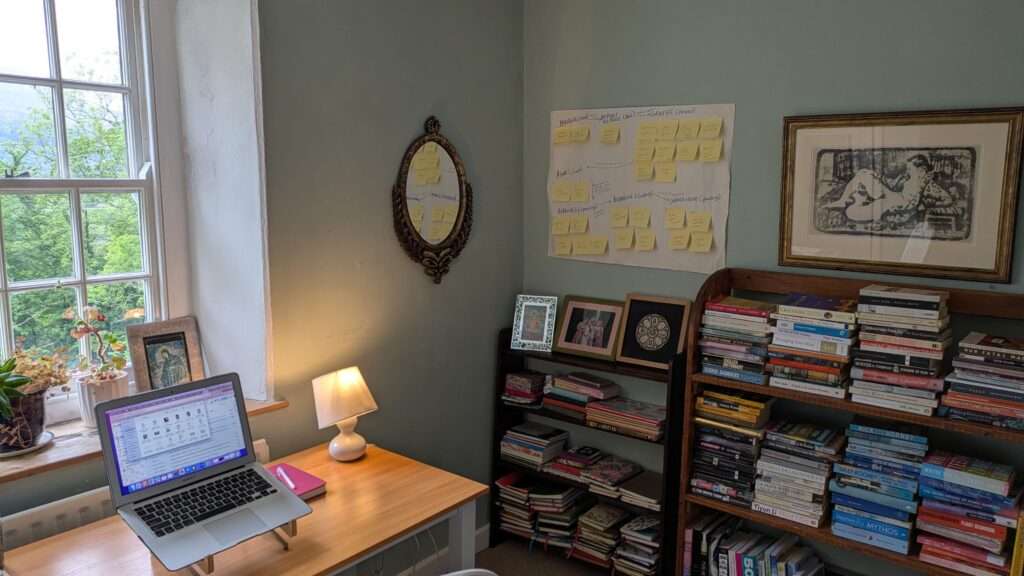
If I’m not having a bed day (which to be honest I can find any excuse for) I write at the desk in my office.
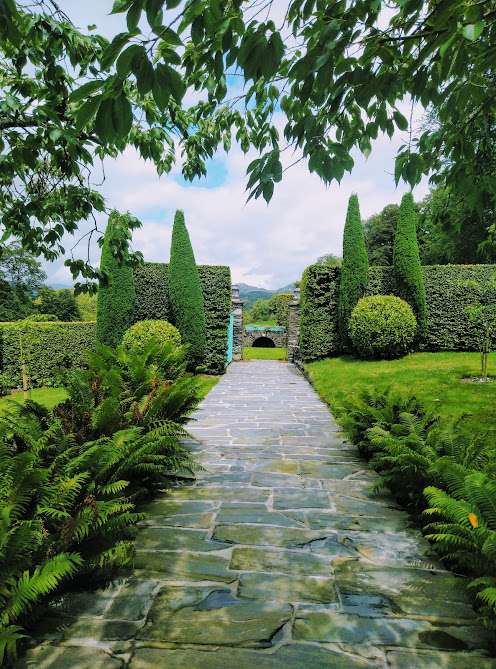
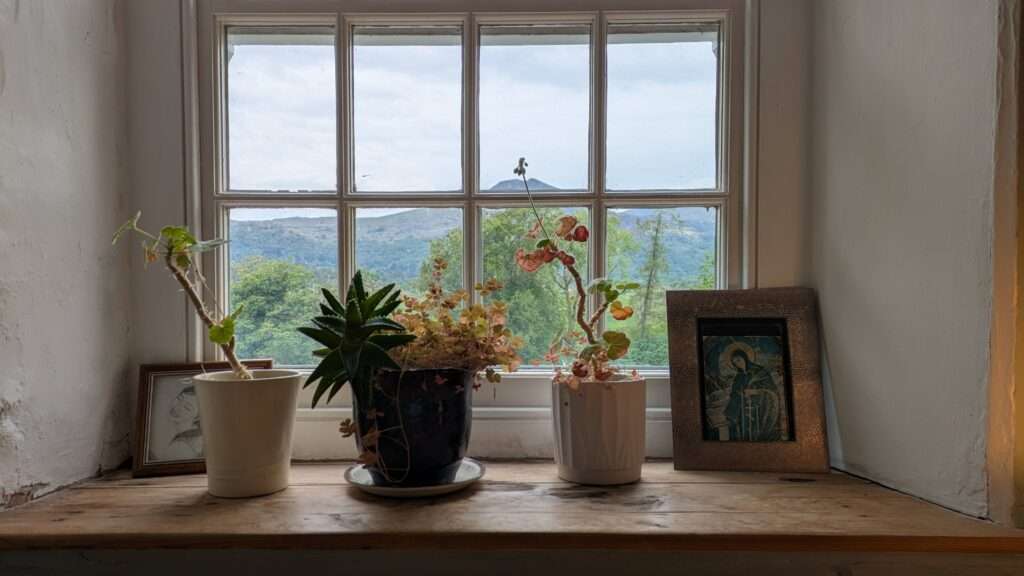
I live in a small village in Eryri called Llanfrothen, in the Brondanw Gardens, the grounds of Portmeirion architect Clough Williams-Ellis’ former stately home. My office window looks out onto a manicured lawn with its topiary and turquoise painted railings. Surprises of Roman-style busts. In the distance: fields, mountains, the open sky streaming with buzzards and crows.
This meeting of the wild and the tame feels like a reflection of my writing life. The intentional arrangement of the natural and the raw. Pruning and fencing in a way that sustains life, fluid and shifting with each season, each passing of the clouds.
When do you write?
My focus is best in the mornings. I try to write morning pages most days, and waking up and free-writing in that hazy fresh from dream space helps untangle my racing thoughts that can so often work against me. Sometimes it’s as mundane as writing down everything I’m worried about or need to get done that day, as a way to declutter.
After years and years of struggling to find a consistent writing routine I’ve finally found one that seems to work. I set myself two hours every morning and block this off in my calendar. I’ll try and use this time to work on my current project, or if I’m really not feeling it, then any kind of related task such as editing or submitting. These shorter, more consistent bursts feel more sustainable than assigning myself whole writing days – where more time can mean more temptation to organise cupboards or get lost online. It also means that I’ve prioritised my writing before anything else which helps me feel anchored.
This is the joy of freelance life – setting my own schedule – and is why I’ve chosen that sometimes precarious path. Still, the amount of time spent thinking about writing or scheduling the time to write versus actual time writing is pretty stark. It helps me to remember that a lot of the writing process happens in the background and sometimes we don’t give the gathering and mulling parts enough credit.
‘This meeting of the wild and the tame feels like a reflection of my writing life. The intentional arrangement of the natural and the raw. Pruning and fencing in a way that sustains life, fluid and shifting with each season, each passing of the clouds.’
And… Why do you write?
Basically, I can’t not. When I have long periods of not writing I feel noticeably more scattered, disconnected, listless. Like I haven’t been plugged in and so everything is a bit duller and life becomes a series of tasks.
When I write I remember this is the closest thing I have found to purpose: digesting experience, bottling moments in words.
I write so I can bare the honest truth of myself in the hope that this will offer consolation to others, in some kind of compassionate mirroring. An extension of palms.
Is there a book or author that has influenced you?
I tend to go blank when I’m asked to choose just one of something, but some books that have stuck with me recently are Liars, Chronology of Water, Kit and Scaffolding. I adore writers such as Deborah Levy and any sort of auto-inspired fiction or sprawling, poetic nonfiction.
And what role does reading play in your creative practice?
As a writer, I feel like when I read something that chimes with me on a cellular level, I am given permission to write more like myself and draw from my own particular, sinewy experience.
Knowing how difficult the writing process can be, and the amount of wilful delusion one needs to carry on sometimes, there is a degree of awe and respect felt when I read something really great. This can help motivate me to stop being so dampened by my ego and get on with my own work, though the resistance is strong and procrastination is a beast I know well. In the best instances, I feel a sense of duty to contribute my own voice to that vast literary dialogue.
As a reader, I’ve always said that no matter what happens, or what goes wrong, at least I’ll always have books. They are my sanctuary and their ability to transport me to other minds and worlds whilst I’m curled up on the sofa suits my house cat tendencies of having an adventurous heart whilst being largely stationary.
Tell us about something you are really proud of.
A few things come to mind. When I was studying at UEA, I was pulled aside by Rose Tremain at an anthology launch who said she was impressed by my story. Self-publishing my book of poetry during Covid and actually earning money from it. Being shortlisted for the Rhys Davies Short Story Award. Getting accepted onto various writers programmes.
Most of all I’m proud that I’ve committed to my writing even though it hasn’t always been easy – with mental health and energy struggles, plus coming from a low income background. There hasn’t been a lot to fall back on and I’ve had to work hard to afford the time to write. I’ve diligently chipped away at it over the years and it feels like it’s paying off in little golden bursts of success.
Being part of Writers at Work is one of those golden moments, and I couldn’t be more grateful.
What’s the best advice you’ve been given as a writer developing your practice?
Expect rejection. Welcome rejection. See each rejection as proof that you’re getting closer to an acceptance, that you’re putting your work out there and seeing what sticks. Also, don’t try to be anyone else. Just because you admire other writers doesn’t mean you should try and emulate them. Your job is to hone the most glittering, precise version of your own voice. You should write about what comes instinctively, what won’t leave you alone.
There are so many ways to have a creative career. What would life as a ‘working’ writer look like for you?
As a working writer, my creative practice would be the priority, and would be given the same weight as other, more direct or conventional ways of making money. I would incubate my ideas and tend to my stories as if they were creatures waiting to be aired. I would feed my words with consistency and attention.
Beyond writing books, there would be lots of different commissions and projects and partnerships. Threads of opportunity spinning and spinning. Variety, always. Curiosity in the not-knowing.
It would involve running workshops in community groups. Writing articles for print magazines. Reading at literary festivals. Collaborating with other writers and artists. Attending residencies abroad.
It would look like being in a room full of people and introducing myself as a writer without that note of hesitation, that wavering, slightly apologetic tilt. My voice would be steady and in that one word, that label, there would reverberate an implicit meaning carrying so much more than placing words on a page.
Silvia Rose is a writer from the mountains of Eryri. Spanning creative nonfiction, fiction and poetry, her writing explores themes of ancestry and place. In 2023 she was selected as an Emerging Welsh Writer by Literature Wales and shortlisted for the Rhys Davies Short Story Award. Her work has featured in anthologies by Parthian and Honno amongst a range of online publications. She was recently awarded a place on the Representing Wales programme and Hay Festival’s Writers at Work.